Thursday, September 28, 2006
Suggested Reading: 9/11 and Terrorism
The Faulk Central Library has a photographic exhibit of images taken in New York City September 11 and 13 after the towers fell. To better understand the events that lead up to the attack, what happened next, and why there is so much hostility between the US and the Middle East, the following books are suggested: Looming Tower by Lawrence Wright, End of Iraq by Peter Galbraith, Fiasco: the American Military Adventure in Iraq by Thomas Ricks, One Percent Doctrine by Ron Suskind, The Great War for Civilisation: the Conquest of the Middle East by Robert Fisk, Imperial Hubris : Why the West is Losing the War on Terror by Michael Scheuer, and A Peace to End all Peace: the Fall of the Ottoman Empire and the Creation of the Modern Middle East by David Fromkin. Please check the catalog for availability or to place a hold.


Tuesday, September 26, 2006
Banned Books Week
Celebrating the Freedom to Read is this week, September 23-30. Observed since 1982, the annual event reminds Americans not to take this precious democratic freedom for granted. This year we can also celebrate the fact that Lucy Collins Nazro and Kathryn Runnells of St. Andrew's Episcopal School were named the recipients of the Immroth Award for Intellectual Freedom, presented by the American Library Association. The award honors intellectual freedom fighters in and outside the library profession who have demonstrated remarkable personal courage in resisting censorship.
The ACLU of Texas Banned Book Project releases an annual report, "Free People Speak Freely," during Banned Books Week. You can pick up a copy of this year's report at the Faulk Central Library until supplies run out. The ACLU of Texas Banned Books Project exists to raise awareness about the level of book challenges and bans in Texas public school libraries, to encourage school officials to use professional librarian standards when confronted with a challenge, and to encourage other ACLU affiliates, library associations, and similar freedom of expression interest groups to conduct similar surveys in their own states.
See ALA's list of the most challenged books in 2005
The ACLU of Texas Banned Book Project releases an annual report, "Free People Speak Freely," during Banned Books Week. You can pick up a copy of this year's report at the Faulk Central Library until supplies run out. The ACLU of Texas Banned Books Project exists to raise awareness about the level of book challenges and bans in Texas public school libraries, to encourage school officials to use professional librarian standards when confronted with a challenge, and to encourage other ACLU affiliates, library associations, and similar freedom of expression interest groups to conduct similar surveys in their own states.
See ALA's list of the most challenged books in 2005
Thursday, September 21, 2006
Book Clubs
The Library's Book Clubs web page has a list of local book clubs, online book clubs, and web sites with lists of recommended titles for reading clubs. If you are not part of a book club now, you should consider joining one or starting your own with friends and co-workers. Why join a book club? One reason is social interaction, it's a great way to spend time with friends and meet new people. A book club can inspire you to read more, or read books that you never would have read otherwise. Book clubs are a way to stimulate ourselves to think and discuss what is going on around us, or to escape into an alternate reality created by a talented author. With so many books to choose from, a book club allows us to help each other find books that are worth reading. Some of the more successful book club titles have been Secret Life of Bees by Sue Monk Kidd, Middlesex by Jeffrey Eugenides, and Life of Pi by Yann Martel. Please check out the line up of the great titles that the Library's book clubs will be reading this fall.
Thursday, September 14, 2006
Book Towns: Paradise for Book Lovers
Next time you are planning a trip, you might consider visiting a book town. The first book-town was founded in 1961 by Richard Booth in the little English village called Hay-o-Wye. Booth transformed abandon houses to bookstores of rare, out-of-print and secondhand books. Against all odds, Booth transformed Hay-o-Wye into the most famous book town and inspired other cities around the world to start their own book town too.
Little towns and villages with panoramic views and historic value are the ones that usually evolve into book towns. To give an idea about the density of bookstores in a book town, visitors might find about 30 bookstores in a town of 2000 habitants. Book-Towns are like a paradise for book hunters: first editions, rare books, and literature festivals are some of the things one can find when visiting these small charming cities.
For more information on book towns here are some links:
Traveling Librarian: Seattle Public Library
While traveling on the West Coast, I stopped in to check out the Seattle Public Library's dramatic glass and steel gem. This building, designed by Rem Koolhaas, is a bit confusing to maneuver (see this Seattle Post-Intelligencer article). As you can see the library is quite large (over 360,000 square feet!) and spirals up eleven floors. As I wandered around, I stumbled upon the "Mixing Chamber". This fifth "floor" houses over 145 public computers and reference librarians who help with the most miniscule question to in-depth research. Above the librarian's desk, there is a huge six-screen electronic installation; this piece of art "uses checkout data to visually display what the community is reading". It is rather interesting, as it resembles a stock market exchange board, but upon closer inspection titles of books dash across its' screens. The non-fiction books are housed above this "floor". The self-guided tour handout describes this section as: "A series of flat tiers connected by gentle ramps allowing [sic] the nonfiction collection to be laid out in a continuous run. Dewey Decimal System numbers on floor mats provide guidance."
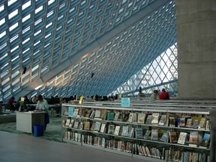
This building made me smile when I saw it and when I meandered around inside. It's huge, it's beautiful, it's forward-thinking, and it is a place worth visiting. - your traveling librarian
This building made me smile when I saw it and when I meandered around inside. It's huge, it's beautiful, it's forward-thinking, and it is a place worth visiting. - your traveling librarian
Tuesday, September 05, 2006
Libraries and Websites for Teens
Social networking sites, which allow users to tap into "friends of friends", continue to grow in popularity. Xanga, a collection of journals, and MySpace, a music-flavored social network, are used by millions of teenagers daily. However, there are indications that the teenagers who made MySpace cool may be moving on to other things. Bebo.com and Facebook, sites aimed at high school and college students, are growing faster.
Now there is legislation in congress that would effectively require most schools and libraries to render these sites inaccessible to minors. The American Library Association has maintained 5 key points regarding the legislation which can be read on the group's Washington Office web page: http://www.ala.org/ala/washoff/WOissues/techinttele/dopa/DOPA.htm
Now there is legislation in congress that would effectively require most schools and libraries to render these sites inaccessible to minors. The American Library Association has maintained 5 key points regarding the legislation which can be read on the group's Washington Office web page: http://www.ala.org/ala/washoff/WOissues/techinttele/dopa/DOPA.htm
Friday, September 01, 2006
Traveling Librarian: La Paz Public Library
The Traveling Librarian Visits Bolivia!!
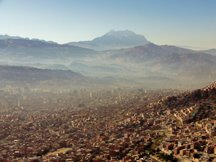 The Traveling Librarian recently visited La Paz, Bolivia, which is one of the two capital cities of this South American country.
La Paz is the highest capital city in the world with an approximate altitude of 10,000 to 14,000 feet depending where you are located within the city. It is so high because it is located in the cordillera of the Andes Mountains.
The mountain in the background above is Mt. Illimani. At over 21,000 ft. it is higher than any peak in North America. The haze in the photo is actually smoke from fires that were burning in the Amazon basin to the north.
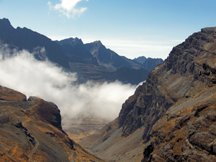
This is a gratuitous shot of the cordillera just east of the city.
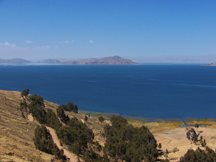
This is a gratuitous shot of the gorgeous Lake Titicaca. It is the highest navigable lake in the world. Despite it's funny name, it is revered by locals.
Of course, the Traveling Librarian also visited the La Paz Public Library (Biblioteca Municipal). In a system with little economic means, this library manages to do quite well, which is a credit to their staff.
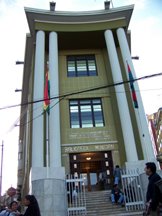
This semi-crooked photo shows the newly refurbished facade of La Paz Public Library.
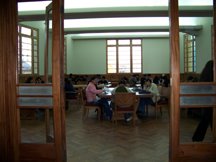 Because the library has limited funds it does not allow people to actually leave the building with the books. In fact, they usually have to provide some type of collateral, such as an ID, to get their hands on the books, which are in closed stacks that are not directly accessible by the public. Nonetheless, the attractive reading rooms were all full.
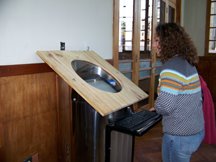
They have limited electronic resources and they guard them zealously.
Visiting the library in La Paz library made me feel lucky for what is available to us here in the States. However, I was very impressed by their ability to make do with limited resources.
The Traveling Librarian is currently visiting the Pacific NW and will have more to report soon!
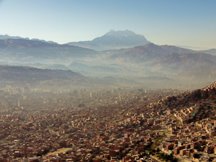 The Traveling Librarian recently visited La Paz, Bolivia, which is one of the two capital cities of this South American country.
La Paz is the highest capital city in the world with an approximate altitude of 10,000 to 14,000 feet depending where you are located within the city. It is so high because it is located in the cordillera of the Andes Mountains.
The mountain in the background above is Mt. Illimani. At over 21,000 ft. it is higher than any peak in North America. The haze in the photo is actually smoke from fires that were burning in the Amazon basin to the north.

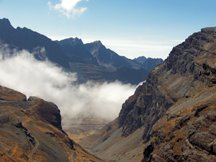
This is a gratuitous shot of the cordillera just east of the city.
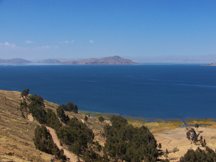
This is a gratuitous shot of the gorgeous Lake Titicaca. It is the highest navigable lake in the world. Despite it's funny name, it is revered by locals.
Of course, the Traveling Librarian also visited the La Paz Public Library (Biblioteca Municipal). In a system with little economic means, this library manages to do quite well, which is a credit to their staff.
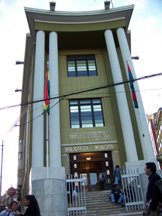
This semi-crooked photo shows the newly refurbished facade of La Paz Public Library.
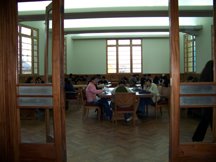 Because the library has limited funds it does not allow people to actually leave the building with the books. In fact, they usually have to provide some type of collateral, such as an ID, to get their hands on the books, which are in closed stacks that are not directly accessible by the public. Nonetheless, the attractive reading rooms were all full.
They have limited electronic resources and they guard them zealously.
Visiting the library in La Paz library made me feel lucky for what is available to us here in the States. However, I was very impressed by their ability to make do with limited resources.
The Traveling Librarian is currently visiting the Pacific NW and will have more to report soon!
Tuesday, August 22, 2006
Traveling Librarian: Speer Memorial Library
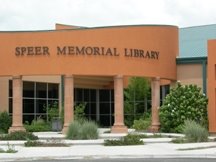 Hello! I've just returned from the Rio Grande Valley where I visited the Speer Memorial Library in Mission, Texas. This wonderful library building has just been through a major renovation. I am told it is now the largest physical public library building in South Texas.
This great library has over 250 Internet computers (!); a bank of meeting and study rooms; a patron lounge stocked with snack machines looking out onto a small garden; a HUGE children's area with plenty of space to lounge around and read a book; and across from the adult reference desk, there are three exhibit displays. Currently, some of the displays featured are: photographs and materials from Cleo Dawson, the author of She Came to the Valley; photographs and materials from the William Jennings Bryan archives; and a memorial to soldiers from the valley serving overseas.
If you're ever in the Rio Grande Valley and want to check out a beautiful public library, Speer Memorial is the place to stop. - Your Traveling Librarian
Friday, August 18, 2006
Back to School...
The summer is over and it’s time to head back to school. Soon, it will be time to write papers and study for exams. Come to the library for help with all your homework woes.
The Wired for Youth page has a “Homework Helpers” link; on this page you can find help for all of the following categories: homework, internet indexes, internet search engines, databases, reference, research papers, biographies, current events, geography, history, government, mythology, people & culture, (full text) books online, math, science project sites, science, TAKS practice tests & readiness guides, and typing!
The Library Database page also has links to databases that can help with all grade levels of homework. There’s even a link for help in writing reports.
It’s all here…just come on in and look around. Don’t forget, call, email, or chat with a librarian if you need help!
The Wired for Youth page has a “Homework Helpers” link; on this page you can find help for all of the following categories: homework, internet indexes, internet search engines, databases, reference, research papers, biographies, current events, geography, history, government, mythology, people & culture, (full text) books online, math, science project sites, science, TAKS practice tests & readiness guides, and typing!
The Library Database page also has links to databases that can help with all grade levels of homework. There’s even a link for help in writing reports.
It’s all here…just come on in and look around. Don’t forget, call, email, or chat with a librarian if you need help!
Wednesday, August 16, 2006
How do you say “Hi” in Tamil?
When we speak to others using our native language, we don’t stop every second to think about how we conjugate verbs, we just speak and they understand. Communication in our own language seems so easy! But in reality, to learn a language is a complicated task, something we figure out when we are trying to learn a foreign language ourselves.
You will have to memorize new words, letters, sounds, pronunciation, spelling and sometimes characters. Plus expressions, idioms, jargon and slang; to learn a new language seem like something impossible to do! But all of this is worth it, learning other languages is also learning about other cultures, other ways to approach life and a wonderful way to make friends!
Austin Public library has language learning resources for approximately 65 different languages! Contact us for more information.
Tuesday, August 08, 2006
How much do you know about traveling libraries?
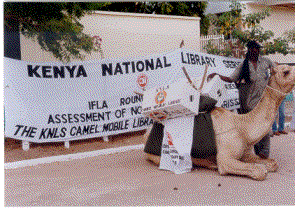
Did you know that the first mobile library known in history belonged to Abdul Kassem Ismail, a Persian vizier who traveled with 400 camels that carried 117.000 volumes through the desert with him? What a personal library!!!
The first mobile library in the United States was a horse-drawn cart and was started by Mary Lemist Titcomb in Maryland in 1905.
Mobile libraries in the world have transported books not only by horse but by donkeys, llamas and camels (like the vizier did!). Cars, trains, boats and lately buses have also transported books to communities with accessibility problems or with limited resources to maintain a library. Very interesting, don’t you think?
More information on traveling libraries:
Wednesday, August 02, 2006
Invest wisely...
OK, your mother wants you to invest some of her money in a Spanish company that you have never heard of. You would like to find some reliable information on how risky the investment would be. You can research what investment experts are saying about the company in Factiva, an online database that has news and business publications from 152 countries in 22 languages, plus company reports and current and historical market data. After searching Factiva, you find that Standard and Poor's has given the company a B++ rating, which is a fair rating, but not secure enough for your mother's investment.
For answers to your database questions and help in how to use them, go to the Austin Public Library's Database Help page.
For answers to your database questions and help in how to use them, go to the Austin Public Library's Database Help page.
Wednesday, July 26, 2006
Traveling Librarian: Library of Congress
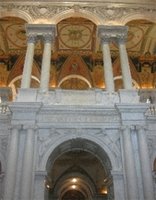 Greetings! I've just returned from the impressive Library of Congress in Washington, D.C! There are three buildings comprising the Library of Congress. I visited the main Thomas Jefferson Building, which is incredibly ornate. The marble walls are decorated with rich murals and mosaics and inscribed with quotations and names of authors and names important to all aspects of history, arts, sciences, and law. Cherubs representing occupations rest along the two main staircases in the Great Hall. There is not room to explain here all of the wonderful artwork and its symbolism; however, you can visit the LOC's website and read the online version of On These Walls: Inscriptions and Quotations in the buildings of the Library of Congress by John Y. Cole. The Faulk Central Library also has a copy of this book available in the 2nd floor reference area. - Your Traveling Librarian
Reading Lists!
Looking for a good book to read this summer? Check out our "Good Reads" page. You can find the best fiction of the year by clicking here. There are also nonfiction, audio, and teen reading lists. Click on the "Notable Books" link to find award winners, classics, and other acclaimed fiction and nonfiction books. And by clicking on the "Reader's Tools" link, you'll find reviews, recommendations, and author interviews.
Enjoy your reading!
Enjoy your reading!
Wednesday, July 19, 2006
Welcome to the Austin Public Library Blog
We're excited to debut our new blog. You'll find everything ranging from things we're reading, watching and listening to; topics related to today's events and news; field trips to other libraries; Texas authors and artists; to library tips, curiosities and controversies. We'll post library related links and promote the Austin Public Library as well.
Feel free to comment on a post, ask a quick question or tell us your library ideas! We look forward to blogging with you!
Feel free to comment on a post, ask a quick question or tell us your library ideas! We look forward to blogging with you!
Subscribe to:
Posts (Atom)

 Posts
Posts