Monday, August 30, 2010

Swindle!

I have a pre-paid cell phone that costs me $15 a month and I'm thinking that the reason it's so cheap is that my provider sells my number to... everybody. I get more garbage phone calls on it than I have ever had on any phone. In spite of the fact that I owe no one a dime (except the library... oops!), I get three or four debt-collectors (looking for Brian or Stephen, whoever they are) threatening me every day! (Well, they would if I still picked up.)

Maybe you're not as stingy as I am and you pay your cell service to block junk calls; still, your computer isn't safe. I bet you've had e-mails from foreign dignitaries down on their luck and looking for a place to park their multi-millions. They'll pay you an enormous fee if you'll agree to babysit their fortunes just until the heat is off. All they need are your bank account and social security numbers. I've had letters from deposed princesses, heads of large corporations on the lam, dames and earls, and not a one of them can figure out how to open a checking account without my help. It's no wonder they're in trouble.

There's no better advice for dealing with scammers than this: just hang up or delete! But if you want information of greater depth, the library has books on the subject. Here are some of them:
And if you're bent on revenge, here are a couple of fun extra-library sites:

Thursday, August 26, 2010

Community Supported Agricultrue

I recently finished a book titled Seasons on Henry's Farm by Terra Brockman and it was lovely. Brockman lives on her brother, Henry's, farm where she and other family members work diligently to provide fresh, organically grown produce to a farmer's market and CSA in Illinois. The CSA, Community Supported Agriculture, program involves local residents purchasing a share of the farm: they make an investment up front and then receive weekly shares of the farm's harvest. By investing in the CSA, residents invest in a sustainable farm and express their commitment to local foods for the sake of our environment and our taste buds.

Reading about the difficult work Brockman and her tight-knit family do every day to keep up with the harvest and farm chores coupled with the long dawn til dusk (and sometimes much later) days gave me a new respect for local farms. The work sounds almost brutal at times, but Brockman and her family approach their chores with an enlightened sense of purpose. Her prose is elegant and graceful as she describes a full year, week-by-week, of life on the farm, while revealing a rich history of family farmers and an intense appreciation for and celebration of the natural world. Farming is truly a labor of love for Brokman and her family making it a beautiful thing to read about it.

There are a number of CSAs serving the Austin area that anyone can join - a few, in fact, are taking new members right now:

FieldFresh
A farm in Seguin. This one delivers to Austin locations as well as surrounding towns like Round Rock and Georgetown.

Green Gate Farms
Located in East Austin and currently taking new CSA members for the Fall.

Johnson's Backyard Garden
Located in East Austin, this one is currently accepting new CSA members and has a very large number of pickup locations and days/times.

Scott Arbor
Located in Seguin.

Urban Patchwork Neighborhood Farms
A community organization of small farms in Austin providing a CSA that is currently accepting members for the fall.

If you're interested in CSAs and farming, you might be interested in these books:

Closing the Food Gap: Resetting the Table in the Land of Plenty


Farmer Jane: Women Changing the Way We Eat

Growing Good Things to Eat in Texas: Profiles of Organic Farmers and Ranchers Across the State

Sharing the Harvest: A Citizen's Guide to Community Supported Agriculture

The Town That Food Saved: How One Community Found Vitality in Local Food

Wednesday, August 25, 2010

Was that a butterfly?


I always feel like I can't never get enough of butterflies. They just go so fast that I get this feeling that I’ve seen something beautiful but I cannot tell exactly how it looks. I can talk about its colors in general but that’s it! No details of the shape of the wings or anything else. On two different occasions I’ve been lucky enough to see the gorgeous Morpho butterfly in Costa Rica: you can only see this metallic blue flash going around, so it is hard to believe it is a butterfly. Amazing!!

Butterflies inside of a cage hanging on the wall are not appealing to me. That’s the best moment to see all their magnificent colors, but the magic is lost. The sense that this gorgeous creature is going to fly away and the urge to enjoy their beauty as fast as you can is gone. But, that’s just me, of course.

Of all the butterflies in the world perhaps the most well known are the Monarchs that migrate very long distances. Because the distance traveled is longer than their lifespan, in some cases the migration includes two or three generations of butterflies. They are indeed amazing creatures.

If you are a fan of butterflies and want to attract them to your garden you are going to need the right plants for that. Texas A&M University has information on how to do this and you can also find more information on this topic at your library:

Monday, August 23, 2010

Stuff


Have you seen the TV shows about people who hoard stuff? Some of them buy second homes to live in after packing their first with stuff and then start filling up the second? One family moved into a tent in their front yard to escape the bugs living in the junk in the house! It's a fascinating disorder because we all can understand it. We want bigger closets and we rent storage lockers and we put off cleaning out our garages. It makes sense to save things we might need later, until saving them becomes more trouble than getting them again.

If the houses in the hoarding shows look familiar to you, here are some books at APL that might help you to understand why:

Stuff
Digging Out
Overcoming Compulsive Hoarding
Buried in Treasures

If all you need to do is tackle clutter, we can help you there, too:

Christopher Lowell's Seven Layers of Organization
Throw Out Fifty Things
Clutter Busting

And if you want to get into the organizing biz, you're lucky to live in Austin. The headquarters of the national organization is here:
National Association of Professional Organizers

(The photo is of the house of Homer and Langley Collyer, brothers who died in 1947 in their New York City brownstone under tons of trash.)

Friday, August 20, 2010

Today's "Grapes of Wrath"

Nobody would deny that times are tough. The poor economic climate is bound to have an impact on books and publishing - and, more specifically, on fiction - as it does on just about every other aspect of life. Looking at the titles below, you may be surprised at how many novelists are creating a literary record of the decade's economic woes, just as John Steinbeck did with his Grapes of Wrath.

American Rust by Phiipp Meyer
Set in a moribund Pennsylvania steel town, this bleak but skillful novel deals with what happens to us when our dreams are shattered, when all that is left is the people we really are, without comfort of daily routine or the promise of a paycheck.

American Salvage by Bonnie Jo Campbell
These short stories are full of characters who know how to fix cars and washing machines, how to shoot and clean game, and how to cook up methamphetamine, but they have not figured out how to prosper in the twenty-first century.

The Hole We’re In by Gabrielle Zevin
Novel chronicles families battered by the recession, unemployment and debt, or minimum-wage jobs.

Dream House by Valerie Laken
A classic money pit scenario offers insights into the fragility of home, family and neighborhood.

The Financial Lives of the Poets by Jess Walter
Funny, heartrending novel is a parable of marriage and money troubles in which a well-meaning family man makes decisions that are seriously stupid but entertaining.

Model Home by Eric Puchner
Travails of a family as they literally lose everything, and finally must move into a failed real estate development in the desert.

This Is Where We Live by Janelle Brown
A novel about subprime mortgages, ruthless Hollywood economics, and the unraveling of a young marriage.

Wednesday, August 18, 2010

The Hitch

Christopher Hitchens had a strange June. His long-anticipated memoir, Hitch-22, hit libraries and bookstores. Within mere days of the memoir’s publication he was informed he has esophageal cancer, which subsequently reached his lymph nodes. Never one to shy away, Hitchens wrote a compelling piece, “Topic of Cancer” in September’s Vanity Fair, depicting his early struggles with chemotherapy. The piece wonderfully expresses the plurality of responding to cancer: fear, resilience, and vulnerability coexist for Hitchens as he continues treatment and sense-making.

Christopher Hitchens polarizes. His writings meld thought and disparate ideologies more eloquently and frustratingly than any writer I have read. The nimbleness of his writing and evolving beliefs reflect Bertrand Russell’s maxim: “I would never die for my beliefs because I might be wrong.” Some might consider this assertion a sign of weakness. Hitchens’ career conveys the beauty within the assertion. His beliefs evolved as he aged. He constantly challenged his beliefs and made adjustments as he determined worthy. Whether you find Hitchens to be a buffoon or a genius, he has remained committed to mental engagement throughout his career. He is infuriating and prescient. Funny and provocative. If only we had more writers like him.

I wish Christopher Hitchens health and I look forward to his further chronicles of treatment.

Below are some of my favorite works by Christopher Hitchens.

Hitch-22

Thomas Jefferson: Author of America

Love, Poverty, and War: Journeys and Essays

A Long Short War: the Postponed Liberation of Iraq


Letters to a Young Contrarian

Monday, August 16, 2010

Bix Beiderbecke

This entry is about a place as much as it is about a person. My original intent was to write about a jazz musician who was highly influential and revered amongst other top players of his generation but remained unknown to the public at large during his life time. As I was digging into this musician's back ground using the libray's catalog and print resources, it dawned on me how great it was that my local library collected, stored, and loaned out not only resources in a wide variety of formats free of change, and had services in place to assist me in getting other materials on my chosen subject such as interlibrary loan and electronic databases, but that a librarian had taken the time to single out and acquire specific choice items for my study and enjoyment. It was all so effortless because many people had already done all of the heavy lifting for me.

That being said, Bix Beiderbecke is considered by some to be the originator of cool jazz. The more I read about his style of playing, the more I am reminded of Miles Davis. Miles Davis would have been five years old at the time of Bix Beiderbecke's death in 1931. Bix, on the other hand, was only 28 when he died of chronic ill health and alcoholism. At a time when jazz musicians were setting the band stand ablaze by blasting out a flurry of notes coupled with flashy, complicated phrasing, Bix Beiderbecke was hanging back, playing fewer notes, and intoning his music with a feeling of introspection and playing it with a precision akin to that of the music of Debussy.

Friday, August 13, 2010

T. rex Sue

On August 12, 1990 Sue Hendrickson, a paleontologist, discovered the "largest, most complete, best preserved" Tyranosaurus Rex skeleton known to the world. This T. rex is 40.5 feet in length, her skeleton weighs 3,922 pounds, and she is estimated to be 67 million years old. It is extremely well-preserved and has contributed to the advancement of our knowledge about the T. rex. She is named Sue, after her discoverer, and she is on display at the Field Museum in Chicago, IL.

Her tremendous size is really just a small part of Sue's story. A court battle lasting 5 years over who owned Sue and her subsequent $8.36 million dollar sale price from Southeby's grabbed headlines years ago. Hendrickson and her colleagues found Sue's bones by chance on the outskirts of a dig they were doing for Black Hills Institute of Geological Research. However, the land on which they discovered Sue actually belonged to a Native American tribe member who later said he had not given permission to Hendrickson's team to keep the fossil they had found and claimed ownership to it. Because the property was ultimately in the trust of the United States government as it is located on a Sioux Reservation, the federal government as well as the Sioux tribe were also laying claims to Sue. The bones were housed at the South Dakota School of Mines and Technology during the long, highly publicized trial until ownership of the bones was awarded to the land owner. The land owner then decided to sale the skeleton at a public auction at Sotheby's.

The Field Museum wanted to put Sue on display for all to see. With the cooperation of several private donors, including Walt Disney World Resort and McDonald's Corporation, Sue was purchased from Sotheby's for the enormous sum of over $8 million dollars. And, lucky for us, Sue is on display for the world.

Read more about how Sue may have died, why she is so well-preserved, and some of the fascinating discoveries that have been made since the fossil was found.

BOOKS

Rex Appeal: The Amazing Story of Sue, the Dinosaur that Changed Science, the Law, and My Life

Tyrannosaurus Sue: The Extraordinary Saga of the Largest, Most Fought Over T. Rex Ever Found

WEBSITES and ARTICLES

Get the Inside Scoop on Sue
The story of Sue from the Field Museum's website

Mighty T. rex Killed by Pigeon Parasite?

Paleontologists Assess T. rex Sue's Pathologies
Sue suffered from many of the same afflictions animals of today are faced with.

Sue on Facebook

Sue Pays Off For Field Museum

This Day in History: Skeleton of Tyrannosaurus Rex Discovered
From the History Channel

View the Many Sides of Sue
Photo galleries, videos and much more from the Field Musuem

Tuesday, August 10, 2010

To Serve Man

My sister bought me a Roomba for my birthday. The name of the company that makes it is iRobot, and Roomba is a robot, all right. It talks, it makes decisions, and it can get itself out of a tight spot (although it has trouble if it's squeezed horizontally--if there isn't enough clearance under the couch, for instance). It runs on a battery that charges on a docking station. There are two metal plates in the bottom of the Roomba that connect with two metal plates on the dock. I was holding the Roomba and aiming to place it perfectly for its first charge when it wriggled in my hands like a poodle! Like it was saying, "Oh just let me do it!". So I let it go and it lined up the connection by itself!

The Roomba is a neat robot, but it's not a heavy-duty vacuum. It couldn't handle the shed hair of my five dogs, so a couple of days after I got it I took it back to the store. I felt sorry for it as I re-packed it in its box. After all, it had tried its best to please me. When the clerk took it out of my hands, I felt like I was leaving a dog at the pound.

We may not have reached the point where we each get a jet pack, but you can have your own robot right now if you want it. To prepare yourself for a mechanical companion, read these books:

Monday, August 09, 2010

Daniel Schorr

I was a child when Daniel Schorr cut his teeth as a seminal and uncompromising journalist. His fearlessness in covering the Watergate debacle of the Nixon presidency earned him meritorious praise from colleagues as well as the ire of certain network television executives and powerful political figures. Daniel Schorr passed away recently at the grand age of 93. His powers of perception, journalist's instincts, and intellectual prowess remained razor sharp to the very end. His voice had been a consistent part of my life since at least the late eighties and I will miss it.

Come to Think of It: Notes on the End on the Millennium

Staying Tuned: A Life in Journalism

Clearing the Air

Friday, August 06, 2010

Kashmir - Paradise Shattered


Kashmir has been in the news a lot lately – the political unrest and the flooding, Kashmir, which was the inspiration for James Hilton’s Shangri-La in Lost Horizon ,was created as a result of the Indian Independence Act of 1947. Kashmir's political problems date back to the 1947 partition, when Pakistan was carved out as a home for Indian Muslims. Kashmir was divided -- and remains divided -- between the two countries. India claims that Muslim-dominated Kashmir is an integral part of the country. Pakistan sees Kashmir as simply an unfinished task of partition. Most Kashmiris would like to be left alone by both sides. Sixty percent of its roughly 10 million residents are Muslim, the remaining 40 percent are Hindu. Estimates vary, but anywhere from 50,000 to 100,000 people have been killed during the conflict. Both sides have committed widespread human rights abuses, creating an environment of fear and distrust.

In the 2005 novel that's set in Kashmir, Shalimar the Clown, by Salman Rushdie, the author's epigraph is “a plague on the both their houses”, referring to India and Pakistan. Salman Rushdie's grandparents, on his mother's side, were born and raised in Kashmir. He and his siblings spent their summers there. To Rushdi, Kashmir is paradise on earth, with its unique combination of intense physical beauty - lush valleys, majestic Himalayas - and a history of tolerance among Hindi,, Muslim and Sikh. But India and Pakistan have trampled over this culture of tolerance. Shalimar the Clown is a tragic love story between a Muslim and Hindi, and a history of Kashmir. A claustrophobic marriage causes a young woman to leave her husband, which begins the transformation of a gentle young man into a ruthless murderer, but the tragedy of Kashmir also contributes to his downfall. The Library has over 20 copies of the book, with just one copy checked out, so there are plenty to go around.

Wednesday, August 04, 2010

Harold Lloyd


I know you might be a big fan of Charles Chaplin or Buster Keaton, and you might think that they are the best silent movies actors. I, on the other hand, think that the best, the most creative and charismatic, was Harold Lloyd - sorry for disagreeing!

His character, a guy wearing a straw hat and horn-rimmed glasses, was a vivid representation of a man from that period of time. He wasn’t a super hero, or a tramp, he was just a man going through life with confidence and a very optimistic attitude. Most of his movies show important innovations on the use of the camera. An example is the famous scene of him hanging from a clock high up in a tower. With a good angle from the camera, he makes us cringe in our seats with a feeling of vertigo, making us believe there was nothing under his feet. This scene was very dangerous to shoot since he was so close to the edge of the building's roof where he was standing, but he kept on going with the shooting, as he did with many other dangerous scenes in his movies. He did all of his own stunts. He also used a test audience to preview his movies to see which parts were good, which ones needed to be redone, and then tested them again, a technique not used by others at that time.

His film Girl Shy is considered the first romantic comedy in the history of film, and his movie Safety Last is considered by the American Film Institute as one of the 100 most thrilling movies. So, if you are ready for the adventure of watching his movies, Austin Public Library can help you with that:

Monday, August 02, 2010

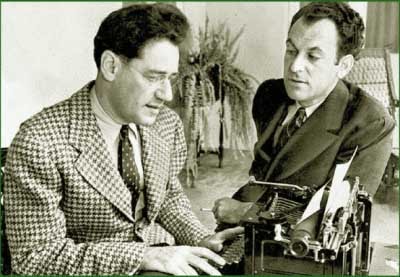
Moss Hart

George S. Kaufman and Moss Hart

It's probably not a good idea to confess this on my employer's blog, but now and then I call in late so I can finish a book. It doesn't happen often. Even with the welter of books published these days, one that I literally cannot put down is rare. But I found one the other day, and I couldn't get to the end in time for work, so I called in late. I had to finish Moss Hart's autobiography, Act One.

Hart wrote and/or directed You Can't Take it with You, The Man Who Came to Dinner, A Star is Born, and My Fair Lady, but you won't hear much about those smashing successes in his book. Act One is about Hart's early years and his struggle out of poverty; about his working without food, sleep, encouragement, and sometimes pay, until he'd made a place for himself in New York theater.

Hart spent summers at holiday camps in the Catskills working as a social director so that he could spend winters writing plays. Six winters, six plays, six rejections. As the seventh winter began, taking up his regular writing spot on the beach (it was quieter than his parents' house in the Bronx), Hart shuffled through last winter's rejection slips. On one of them was written some advice: the funny parts are good; why don't you try comedy?

The second half of Act One is the story of the herculean work that went into writing, selling, and staging that comedy, the Kaufman/Hart play Once in a Lifetime. Hart tells how the play evolves, from first draft through rewrites, through out-of-town runs and rewrites, through hope and despair and more rewrites, and failure and rewrites and another chance and rewrites and last-minute rewrites, to opening night on Broadway.


The story is as funny, entertaining, and suspenseful as any I've read, and Hart has important things to say about hard work and perserverance and luck. A well-written book about showbiz is a rare thing. The critics loved Act One when it came out in 1959 and it holds up today. If you liked Russell Baker's Growing Up, put Moss Hart's Act One on your reading list.

Kitty: An Autobiography by Kitty Carlisle Hart (Mrs. Moss)

Friday, July 30, 2010

Alice

I recently re-read Alice in Wonderland and Through the Looking Glass by Lewis Carroll and it helped me remember how in love with this fairy tale I was as a child. The idea of slipping off into a world that you could freely explore where nothing was as it seemed very much appealed to my young imagination. As evidenced by the numerous book and movie adaptations and spin-offs, it obviously appeals to many people. I think a few things contribute to its appeal: the novelty of the nonsense world Carroll created, seeing everything from the unique child-like perspective of Alice herself, and an element of horror always in the background and sometimes center stage. But there's more to it than that. A poet W.H. Auden said of Alice:

"...one of the most important and powerful characters is not a person but the English language. Alice, who had hitherto supposed that words were passive objects, discovers that they have a life and will of their own. When she tries to remember poems she has learned, new lines come into her head unbidden and, when she thinks she knows what a word means, it turns out to mean something else."

I couldn't agree more. Carroll's nonsense verse and plays on words are one of the reasons I have re-read this book several times!

You can indulge your love of all things Alice at the library. We have the originals, the adaptations, and the spin-offs. Here's a sampling:

BOOKS

Alice I Have Been: A Novel
Alice Lidell, who Alice in Alice in Wonderland is based on, is the protagonist in this well-reviewed novel.

The Alice in Wonderland Cookbook: A Culinary Diversion

Alice's Adventures in Wonderland and Through the Looking Glass
Carroll's original two books about Alice and Wonderland - this edition includes the original illustrations by John Tenniel.

The Annotated Alice
Includes both Alice and Looking Glass w/ Tenniel's illustrations and annotations by Martin Gardner, an expert on Carroll and Alice.

The Looking Glass Wars
Great YA and up spin-off on Wonderland - this is the first in a trilogy that includes Seeing Redd and ArchEnemy. If you like these books, you might also try the graphic novels based on them, Hatter M.

The Mystery of Lewis Carroll: Discovering the Whimsical, Thoughtful and Sometimes Lonely Man who Created Alice in Wonderland

MOVIES

Alice
TV mini-series spin-off with a grown-up Alice revisiting a changed Wonderland. Kathy Bates stars as the Queen of Hearts.

Alice in Wonderland
Spin-off directed by Tim Burton starring Johnny Depp

Alice in Wonderland
Walt Disney's animated adaptation

Lewis Carroll's Alice in Wonderland
1933 adaptation featuring Cary Grant, W. C. Fields, and others

Wednesday, July 28, 2010

Ah!! Bel Canto!


On Sunday afternoons, my grandpa will close the door of his room, lie down in bed, and listen to the opera radio show. I grew up listening to this type of music (some snoring included in the background.) It was very simple; no one told me I had to like it or taught me about the most relevant exponents of it or its history. I just learned to love it because of him.

It is when I started reading more about it that the topic gets more complicated but not less interesting. I learned that Singspiel, semi-opera, operetta and opera comique are some of the different types of operas. Each one defined by the plot and the combination of spoken dialogue, music, or dancing roles. I learned also that Jacopo Peri, an Italian composer and singer, is the author of Dafne, known as the first work considered an opera, played around the year 1597. Claudio Monteverdi, another Italian composer is also considered one of the pioneers of this type of music, and his opera titled L’Orfeo that was first played in 1607 is still performed nowadays.

Despite the fact that this music style is more than 500 years old, opera is still popular today. Francesco Cavalli, Rossini, Bellini, Verdi and Donizetti, are some of the most important exponents of this genre that I am sure you’ve heard about. Arias like “La donna è mobile,” “Nessum dorma, ” and “O sole mio” are now pretty much everywhere, from TV ads to music boxes. During the 90s José Carreras, Luciano Pavarotti, and Plácido Domingo captured the attention of millions with their famous tours and concerts around the world. Currently, bands with different music styles, like East Village Opera Company does interesting covers of famous arias that you might enjoy.

Some books about the topic you could check out are:

Monday, July 26, 2010

Oenophilia*

These days wine is made all over the world, but 34 years ago fine wine was presumed to come only from France. And then, on a spring day, somebody held a little contest in a Paris hotel...

In 1976, as part of the French celebration of the U.S. bicentennial, Stephen Spurrier, the British owner of a Paris wine shop, conceived an event he thought would pique interest in French wines and maybe prove them superior once and for all: a blind taste test. France v. California. Bring on the snobs, er... wine tasters.

Guess who took first place. It is a competition so famous (if you're French, infamous) oenophiles commemorate it as the "Judgment of Paris". At first the French ignored the results, then they waved them away as subjective and statistically insignificant, then they insisted that French wines age better. So 30 years later the tasting was restaged, the old bottles dusted off, the judges back for another try. Guess who won again.

Why Hollywood took so long to turn this Cinderella story into a movie I do not know, but now there are two. Unless you're an Alan Rickman fan, don't bother with the first film, Bottle Shock (2009). Instead, bide your time watching Sideways (2005), and cross your fingers that the second movie about the taste test, Judgment of Paris, due out this year, tells the story with the piquancy it deserves.

The winning cabernet is for sale online, and the chardonnay was just auctioned to raise money for Haiti. If you can't spend $2000 on wine, enjoy this sour grape: in 2006 Forbes judged the chardonnay past its prime. (Have a look at both bottles on exhibit at the National Museum of American History at the Smithsonian.)

Books to sip wine by:

Judgment of Paris by George Taber
Academie du Vin Complete Wine Course by Stephen Spurrier
Wine Appreciation by Richard Vine
The Pocket Wine Book
by Hugh Johnson

* pronounced ee-no-FEEL-ya

Friday, July 23, 2010

Mad Men


The cult TV hit Mad Men enters its 4th season this Sunday night. The Library has a book coming soon for the show’s many devoted viewers - Mad Men Unbuttoned: A Romp through 1960s America by Natasha Vargas-Cooper.

The author is an enthusiastic fan of Mad Men (she operates a
Web site with the same name as the book). She uses the show, about advertising executives in the 1960s, as sort of a portal into the decade, which was the golden age of Madison Avenue - a time when chain-smoking was in, gender equality was out, and the talk was as smooth as the three martinis at lunch. She discusses some real-life advertising giants (Ogilvy, Burnett, Daniels), talks about social mores (particularly sex), and discusses early 60s books, movies and music. But as one TV critic said, "No matter how many iconic shots there are of Don Draper taking a drink or having a smoke, or how the wardrobe looks or who made the office furniture, there's only one overriding theme in Mad Men: identity."(www.sfgate.com)

If you haven’t watched the show, or need to catch-up, the Austin Public Library owns season one, two, and three. If you would like read novels of that era, try a book off one of the following lists:

Recommended Reads:

Bullet Park by John Cheever
The Learners by Chip Kidd
The Man in the Gray Flannel Suit by Sloan Wilson
On Chesil Beach by Ian McKewan
Rabbit, Run by John Updike
Revolutionary Road Richard Yates
When All is Said and Done by Robert Hill

Books the characters have been seen reading on the series:

The Agony and the Ecstasy by Irving Stone
Exodus by Leon Uris
The Group by Mary McCarthy
The Sound and the Fury by William Faulkner
Lady Chatterly’s Lover by DH Lawrence
Ship of Fools by Katherine Anne Porter


Wednesday, July 21, 2010

Are you prone to peek??


 I cannot understand the why or the philosophy behind peeking at the end of a book you are reading. I guess I am what you would call a “linear reader,” which simply means that I read a book from beginning to end; I don’t read the beginning of the next chapter, or skip pages, or read the beginning of the last chapter or the last sentence of the book. Nope! I just love the idea of being surprised by the end of the book. I like seeing how the plot evolves and changes and how the writer takes you to unexpected places or situations. I like to see the process as it happens while you read the book in its original order. But, if we are talking about poetry books, magazines or newspapers, well, I am all over the place - not “linear” at all! Some people read their newspapers or magazines back to front and others only read certain sections of them. Some others peek depending on the genre: romance, yes, but never mysteries.

The more I talk to people about the way they read, the more I learn about all the interesting things they do. A friend told me that he knows his favorite author often has a character in his books that has a great heart, great personality and is just a very good, nice person. But this is the person that often gets killed at the end. So, my friend stops one or two chapters before the ending and creates his own where the nice character continues alive and well. Interesting don’t you think??

Rereading is another thing I don’t ever consider, but people often do. They have a selection of books that they reread every couple of years or so, and in some cases, they even mark sentences or phrases with different colors, one for each year, so they can see what was important to them at a certain point in time.

At the end, no matter what you do, just enjoy your reading!! If you are looking for something to read during this summer, don't forget about our Good Reads page with tons of good information and ideas on what to read next. Have fun!

Monday, July 19, 2010

Mountain Music


I tremble to say so in Texas, but I don't care much for country music. Of course I like Willie and the Dixie Chicks, and I like a couple of the really big hits like "Stand by Your Man" and "Crazy" and... um... that might be it. I'm a Yankee.

So imagine my surprise in 2000 when, after seeing the Coen brothers' old-timey country-music fest O Brother, Where Art Thou?, I found myself driving straight to Waterloo Records to buy the soundtrack.

The album's popularity also surprised Dr. Ralph Stanley, the 70-year-old musician featured on O Brother. He and his brother Carter had had some success after World War II as the Stanley Brothers and the Clinch Mountain Boys--they'd had some flush times and made records for a national audience--but they'd never hit it really big like Lester Flatt and Earl Scruggs. Even I had heard of Flatt and Scruggs, but until O Brother, I had never heard of Ralph and Carter Stanley.

Dr. Stanley has written a wonderful book (with Eddie Dean) about being a kid in Appalachia and learning music handed down through generations; about writing songs in the car speeding down a dark road to a play date, arguing with promoters, dealing with troublesome band members, finding musicians whose talents blend into the sound he wants, and what happened to his career when Elvis sang "Blue Moon of Kentucky". He talks about losing loved ones and staying true to the old-time music and winning a Grammy at age 70 for his rendition of "O Death" in O Brother.


Man of Constant Sorrow: The Life and Times of a Music Legend recounts 82 years of writing and playing mountain music, but you don't have to be a fan of the music to admire the book. Dr. Stanley would understand, I think. After all, he doesn't care much for rock and roll.

Friday, July 16, 2010

Alarm Bells

I’m reading a fantastic yet utterly frightening book right now called Eaarth by Bill McKibben. McKibben was one of the first to write a book about climate change geared toward a general audience, called The End of Nature, and he has written several books since, Eaarth being his most recent. The book is titled Eaarth because this is the new name McKibben has assigned to the new planet on which we live – one where natural resources are becoming scarcer, the climate is changing surprisingly rapidly, and the level of carbon dioxide in the atmosphere is higher (392 ppm) than the level deemed safe for humanity by scientists (350 ppm; see this webpage for more information). He informs us that we have altered our old planet in so dramatic a way that many of the rules that once applied to it no longer do. To further exacerbate this, our country, at least, but really the entire planet has been pursuing growth and planning for growth continuously. Considering we do not live on the old planet we used to, we will not have the resources, such as oil and water, to sustain growth. In fact, there is much evidence that we soon will not have the natural resources to support ourselves at current capacity.

McKibben spends the end of the book trying to work out how we might live on this new planet we’ve created through global warming and exhaustion of resources. Largely, it’s a sort of get local, do it yourself message. He doesn’t believe there is anything we can do to get back to our old planet, but he does believe that we can exist on the new planet if we start learning to produce things for ourselves. For example, if I’m capable of producing my own food, then the poor yield on wheat and/or the lack of any fish in the ocean for fisheries to catch and provide to my supermarket won’t affect me as much. McKibben calls for governments and people to rid themselves of an expansionist, global point of view and get back to basics. Bigger is not better. In fact, bigger is ruining our chances at surviving on this so-called Eaarth.

It would be easy for me to get in far more detail here as the book makes many interesting points and is heavily researched with excellent notes. But I’ll leave it to you to pursue along with all of the other great resources we have to help connect you with the information you need!

BOOKS

Deep Economy: The Wealth of Communities and the Durable Future

Eaarth: Making a Life on a Tough New Planet

Permaculture: Principles & Pathways Beyond Sustainability

State of the World 2009: Into a Warming World: A WorldWatch Institute Report on Progress Toward a Sustainable Society

WEBSITES and ARTICLES

350.org
Founded and lead by Bill McKibben 350.org is "an international campaign that's building a movement to unite the world around solutions to the climate crisis - the solutions that science and justice demand. Our mission is to inspire the world to rise to the challenge of the climate crisis — to create a new sense of urgency and of possibility for our planet."

Artic is Melting Even in Winter

Bill McKibben discusses Eaarth (a podcast)

Climate Changing ‘Faster, Stronger, Sooner’

Climate Warming Means Food Shortages, Study Warns

The End of Car Culture*
*Requires an APL card to access from home