Thursday, April 29, 2010

The Protest Singer

Folk legend Pete Seeger's birhday is Monday, May 3. He and Woody Guthrie travelled America in the 1940s, bolstering labor movements and civil rights protests with song as they blended activism and folk music. In 1942, Seeger joined the Army, where he continued to play and sing, performing for the other soldiers. In 1948, he started a group called The Weavers. In line with Seeger’s political ideals, the group wove a mix of vocals and music with social and political commentary. Unfortunately, by the time the group was becoming popular, the political climate of America had soured. McCarthyism held the country in a firm grasp of fear, and the Weavers were soon banned. Seeger was among the first to write songs questioning the Vietnam war. The Smothers Brothers show shattered the 17-year TV blacklist against Seeger, insisting that he perform "Waist Deep In The Big Muddy," a song inspired by a photo of American soldiers slogging through a river in the Mekong Delta. He stood beside Paul Robeson when he was attacked by the Klan at Peekskill and marched with Martin Luther King from Selma to Montgomery. Five years before Greenpeace was founded, Pete launched his own environmental campaign on the Hudson. To mark the awe-inspiring 91st birthday of Pete, have a sing along, read his biography, listen to a cd, green the world, or join a protest.

Wednesday, April 28, 2010

Cell phones and Poetry


Last week, while I was sitting in the train, waiting to depart, I wondered about what could be a good topic to write about in my next blog. Suddenly I remembered that April is Poetry Month and started thinking about poetry books, authors, and other related topics that might interest you. My thoughts, however, were abruptly interrupted by a person’s loud conversation on her cell phone, and another, and another. Then I decided to combine the two elements that I had in my mind, cell phones and poetry, and here is the result:

Bridal Shower
by George Bilgere

Perhaps, in a distant café,
four or five people are talking
with the four or five people
who are chatting on their cell phones this morning
in my favorite café.

And perhaps someone there,
someone like me, is watching them as they frown,
or smile, or shrug
at their invisible friends or lovers,
jabbing the air for emphasis.

And, like me, he misses the old days,
when talking to yourself
meant you were crazy,
back when being crazy was a big deal,
not just an acronym
or something you could take a pill for.

I liked it
when people who were talking to themselves
might actually have been talking to God
or an angel.
You respected people like that.

You didn't want to kill them,
as I want to kill the woman at the next table
with the little blue light on her ear
who has been telling the emptiness in front of her
about her daughter's bridal shower
in astonishing detail
for the past thirty minutes.

O person like me,
phoneless in your distant café,
I wish we could meet to discuss this,
and perhaps you would help me
murder this woman on her cell phone,

after which we could have a cup of coffee,
maybe a bagel, and talk to each other,
face to face.

Poem reprinted with author’s permission.

Below are some books that would help us get along:
And if you like this poem, here is a book by the same author:

Monday, April 26, 2010

Screenplays at APL

Are you an aspiring screenwriter? Austin is the place to be--well, one of the places to be--to see movies and attend movie-making seminars. We are a festival city indeed: there are the Austin Film Festival, AGLIFF, and FantasticFest in the fall, and SXSW in the spring.

At any time of year, Austin Public Library can augment your screenwriting education; there's no better way to learn to write a script than to study scripts, and APL has quite a few. Search the library's catalog for 'shooting script' to find The Dark Knight, Nurse Betty, Adaptation, Sideways, The Eternal Sunshine of the Spotless Mind, and more. And at that same spot on the shelf (791.43), you'll find screenplays (as opposed to shooting scripts) as well as books on how to write them. The library owns a copy of the book pictured here, the screenplay (about a screenwriter!) of the 1950 thriller, In A Lonely Place, which you can also get from us on DVD.

APL has the whole package: screenplays, instruction on writing them, and the finished product: movies!

Friday, April 23, 2010

Federal Writer's Project


In 1935, at the height of the Great Depression, Franklin Roosevelt proposed a federal program, the Works Project Administration (WPA), to employ people on relief. Critics called the WPA communist, anti-American, a government make-work boondoggle, but because of it, Central Texas has a series of flood-control reservoirs on the Colorado, a survey of Texas folk art at the National Gallery in Washington, D.C., and Deep Eddy pool (to mention only a few of just the Texas WPA projects).*

One of the programs under the WPA was the Federal Writers' Project which employed writers to collect and compile histories and stories of people across the country. John Cheever, Nelson Algren, Saul Bellow, Ralph Ellison, Zora Neale Hurston, John Steinbeck, and Studs Terkel are a few of the writers who earned about $100 a month working for the WPA. They produced American Life Histories, the Slave Narratives (both at the Library of Congress), and the American Guide Series: guidebooks to the states that are still popular with tourists.

The Austin History Center is currently exibiting memorabilia and collections from Austin's experience of the 1930s and 40s called Relief, Recovery, & Progress: The Great Depression and the New Deal in Austin. While you're downtown to see it, stop next door at the library and check out the books of the authors listed above and see works from the Federal Writers' Project that the library owns, and have us order the ones we don't own through interlibrary loan.

And while you're surfing, re-read a previous blog entry, a book report on Leonard Todd's biography of the slave potter Dave, written with the help of the Writers' Project's Slave Narratives at the Library of Congress (links above).

Wednesday, April 21, 2010

Volcanoes and Ash Oh My!


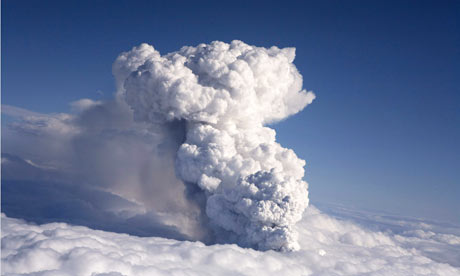
Our world continues to shrink. We communicate instantaneously. Trade knows no border. I know global soccer scores as they happen. In this hyperworld, not much surprises us. We feel as if we've mastered nature. Yet, occasionally something happens that makes us feel small again, makes the world seem incomprehensively large, and leaves us in awe. One of those moments happened last week when an Icelandic volcano erupted. The subsequent cloud of ash spread throughout Europe, grounding planes and stranding thousands of travelers. European airspace opened this morning after almost a week of closure. Estimated airline losses have reached almost $1.7 billion.

The situation has left me with a childlike misunderstanding: a volcano more than 1500 miles from mainland Europe almost shut down the continent. That is something awesome to consider.

In my younger days I made a ketchup volcano for an elementary school science fair. Perhaps that laid the ground work of intrigue. Either way, this very real volcano has me curious. I look forward to perusing the following books.

Furnace of Creation, Cradle of Destruction: a Journey to the Birthplace of Earthquakes, Volcanoes, and Tsunamis

Volcanoes: Eruptions and other Volcanic Hazards

Worlds on Fire: Volcanoes on the Earth, Moon, Mars, Venus and Io

Krakatoa: the Day the World Exploded, August 27, 1883

Volcanoes


Monday, April 19, 2010

Walking the Trails

This causeway once carried the Rutland Railroad over portions of Vermont's largest lake,
Lake Champlain
. Public Domain photograph.

Now that spring has sprung, I like to get out and walk around. Summer is going to be here before you know it and I want to enjoy the trails and wonderful weather before it's gone! I recently read a NYT article about the High Line in New York City. It looks like a wonderful re-engineering of something that is no longer used for what it was created. There's another organization, Rails to Trails, that does the same thing across the country. Check out this list of trails in other parts of the world. And, of course, our beloved Austin has some great trails to traverse, look over the trail directory and maps and enjoy the trails near you!

The library has a wonderful collection of books and maps on hiking and getting outdoors, check some out before you head out.

100 classic hikes in Texas : Panhandle Plains, Pineywoods, Gulf Coast, South Texas Plains, Hill Country, Big Bend Country, prairies & lakes by Dan Klepper

60 hikes within 60 miles, San Antonio & Austin, including the hill country by Tom Taylor

Big Bend National Park, Texas, USA: Trails illustrated map by National Geographic Maps (you can check this out!)

Every town needs a trail : Lady Bird Johnson's quiet legacy : the city it shaped and the people it inspires by Jen Ohlson

Friday, April 16, 2010

Kiss of the Wolf (in Italian)

In John Irving’s twelfth novel, Last Night at Twisted River, a father and son carry a misspelled Italian surname – Baciagalupo. Literally, the name means "kiss of the wolf," from "bacio" (kiss) and "lupo" (wolf). This name is repeated over and over in the novel, and is finally used for the name of a restaurant. I thought John Irving had just made the name up entirely, but then I came across “Bacigalupi" as the author of the 2009 science fiction novel, The WindUp Girl, which was just added to the Library’s list of Best Recent Science Fiction and Fantasy. It was a fun moment, when two random experiences intersected.

Anyway, here are reviews of these two books:

Last Night at Twisted River
Dominic Baciagalupo, a cook for a logging community, and his son Daniel are co-protagonists in a story about manhood, family, love, friendship, and a lot of Italian cooking. The novel moves slowly back and forth in time. At times, it may move a bit too slow with all the detail, but Irving is a master at connecting the details and characters to create a book with a deep message. The first section of the book is set in the 1950s in the far north of New Hampshire. In the last half of the book the son, now grown-up and an author, struggles with the tragedies of his life - both accidental and avoidable - and with writing novels, striking a balance between the autobiographical and the imagined.

The Windup Girl
Paola Bacigalupi has been compared to William Gibson, Neal Stephenson, and China Miéville. In this near future thriller, calories are the greatest commodity, and corporations control the world’s seed stock. Bacigalupi has created a compelling, if bleak, society in which corruption, betrayal, and despair are commonplace, and more positive behavior and emotions such as hope and love are regarded with great suspicion. The windup girl of the title is a "New Person," a genetically modified girl brewed up from scratch by the Japanese as a toy. But her DNA is not so compromised that she doesn't still yearn to be human. The complex plot revolving around her, a future Thai kingdom, and many other complex characters require a great deal of commitment from readers.

Tomorrow is the last day of National Library week, so visit your neighborhood branch or come to Faulk Central for the
New Fiction Confab.

Wednesday, April 14, 2010

A Spark of Light on a Spotless Mind


There is a quotation by Pablo Picasso that says “Everything you can imagine is real,” and if we think about it carefully, it is true. Most of the books we read and the music we listen to was inspired by a little piece of reality. Have you ever wondered, what did inspire an author to write a book or an artist to create this masterpiece? What factual bit of information made this writer jump in his/her chair and start sketching the frame for his/her next novel?

What inspired a good book is not always known but in some cases, when writers tell us the source of their idea, the story they tell us is equally or more fantastic than their work itself. Such is the case of the book “Of Love and Other Demonsby Gabriel García Márquez. In the preface of this book he tells an amazing story about a convent in Cartagena, Colombia that was going to be transformed into a five star hotel. The tombs of those whom 200 years ago were considered important people were still there and were being exhumed. When they opened one of the graves, they found the skull of a young girl with a splendid head of hair that measured 22 meters long. García Márquez was very young at that time and was a witness to this event which he was covering as a journalist. At that moment he knew he would be writing a book based on this story sooner or later.

Sometimes, the beginning of a book can be as simple as a stewardess asking you “Beef or pasta?” That’s what happened to Andrew Rimas and then he wrote the book: "Beef: The Untold Story of How Milk, Meat, and Muscle Shaped the World." Or like in the case of Russell Banks who wrote his novel “Continental Drift after reading a newspaper clipping about refugees from Haiti arriving on the shores of Florida. In some other cases, authors have found their inspiration in their personal interest like in "Halide’s Gift" a novel by Frances Kazan written because its author’s fascination with a particular time in history: when the Islamic and Ottoman Empires were about to collapse and a woman named Halide played an important role during this chaotic time.

Inspiration is an elusive friend: sometimes it will show its face in every corner, but it could also hide for months at a time, leaving without notice which could be an author’s or artist's nightmare. In the meantime, let’s sit back and enjoy a reflection of reality in the books we read.

Monday, April 12, 2010

Bamberger Ranch

Need another reason to let your St. Augustine parch this summer? Check out Bamberger Ranch Preserve, a land reclamation project/working ranch in Johnson City.

Ever eat Church's fried chicken? David Bamberger got rich selling it to you, and then bought the scrubbiest, most over-grazed tract of land he could find in Texas and began to turn back the clock. He replaced thirsty cedar with native grasses and watched as water pooled in dry gullies and dead springs bubbled back to life. And as the water came back, so did birds and other animals, and the deer got fatter (and tastier!), and now people who thought Mr. Bamberger was crazy (he had a hard time convincing his realtor that he really did want the worst possible acreage) are coming to him for advice.

You can see the ranch yourself if you call and ask for a tour. And after you've read this post, re-read APL's other recent water-conservation blog entries, Dig Holes and Dry Gardening with the City.

Here are links to David Bamberger's book about his ranch, Water from Stone: The Story of Selah, Bamberger Ranch Preserve, and other books on water conservation on the shelves of your Austin Public Library:

Heart of Dryness: How the Last Bushmen Can Help Us Endure the Coming Age of Permanent Drought, James G. Workman

Unquenchable: America's Water Crisis and What to Do About It,
Robert Jerome Glennon

Rain Gardens: Managing Water Sustainably in the Garden and Designed Landscape, Nigel Dunnett

Friday, April 09, 2010

James Tiptree, Jr.

I just finished an excellent biography, James Tiptree, Jr.: A Life of Alice Sheldon. Sheldon was a science fiction author who only started publishing stories in the genre while in her 50s during the late 1960s. She wrote under the pseudonym James Tiptree, Jr. and for a little over 10 years of her sci-fi writing career no one realized she was a woman, including her own agent. Tiptree corresponded by mail with writers such as Phillip K. Dick and Ursula Le Guin, both of whom admired his work, and his stories received much critical praise. In his letters Tiptree used Sheldon's own autobiography as his own. In 1977 when Sheldon's mother died Tiptree wrote of it in several letters. This led many to deduce that Mary Hastings Bradley was in fact Tiptree's mother and, considering Bradley only had one child - a daughter, it revealed Sheldon's true gender. Sheldon's career dwindled after the revelation and she eventually killed herself along with her husband in 1987 in what was a sort of mutual "suicide".

Sheldon's struggle with gender and sexuality were central to her life and her stories. As a young woman in the 1930s, Sheldon found her options (largely, marriage) limiting. She questioned her sexuality and felt a strong attraction to women that she never really pursued due to social taboo. She certainly addressed issues in her stories that no woman could have written about during that time and been taken seriously. It was only under her male pseudonym that Alice could write freely and receive the praise and respect her writing deserved. Sheldon later said of the identity revelation in an interview, "A woman writing of the joy and terror of furious combat, or of the lust to torture and kill, or of the violent forms of evil--isn't taken quite seriously.... I think that for all of us the sense of being in contact with something that has the potential to do--or maybe (wow!) has done--real evil, gives a little thrill to reading. Some people seem to have projected that onto Tiptree. Maybe I did a little too. So to write on as a toothless tiger was shaming."*

*The quote in this article comes from Biography Resource Center, which you can access from home with your library card. This resource far outshines Wikipedia because the articles are written by respected authorities on the individual and come complete with excellent bibliographies.

Crown of Stars

James Tiptree, Jr.: A Life of Alice Sheldon

Out of the Everywhere and Other Extraordinary Visions


Up the Walls of the World


The Very Best of Fantasy & Science Fiction: 60th Anniversary Anthology
Includes "Women Men Don't See", one of Tiptree's more famous stories

Wednesday, April 07, 2010

Iconic Buildings in the Mideast


What is an iconic building? When I first saw the term, I immediately thought of Greek columns – Doric, Corinthian, and Ionic. But iconic of course refers to icon, as in being famous, or being a symbol for a culture or time. The term icon originally referred to a religious painting, but nowadays it can be applied to everything from individuals to gadgets to buildings. Iconic status should only be conferred after a building has been built and shown to symbolize something to a wide audience, but often new buildings are called iconic. Iconic buildings we all know are the Empire State Building, Eiffel Tower, and Sydney Opera House. Now with global capitalism, very tall skyscrapers or culturally unique buildings are popping up all over, especially in the Mideast. For example, Burj Khalaifa in Dubai which is AT THE MOMENT the tallest building in the world at 2,717 feet high, more than a thousand feet taller than the Empire State Building. A New Yorker article says the residential building “has a magnetism that is lacking in almost every other super-tall building of our time.” There are even taller buildings planned in the Mideast. The Nakheel Tower in Dubai will be more that 200 floors and 3,281 feet high. A recent NYT article describes the new design by Jean Nouvel for the National Museum of Qatar that captures the Bedouin culture, which may one day be considered iconic.

APL has a fairly recent book to help you understand what an iconic building is.: The Iconic Building . With a mixture of wit, irreverence and sympathy, leading architecture critic Charles Jencks surveys the recent history of the iconic building and then focuses on ten key examples.

Monday, April 05, 2010

Bomba Estereo

I've been listening to a group from Colombia lately that is full of all the energy, fervor, passion, and promise of youth. Their name is Bomba Estereo (watch the live video performance of their song, Feelin'). They were recently in town as part of the SXSW music festival. Sadly, I discovered them after the fact but I imagine the show was a lively and festive dance party as their music implies. Another recent attendee was Chocquibtown. They are another group from Colombia garnering critical praise and are equally as vibrant as their compatriots. Yet another more established sublime Colombian group that has visited Austin in the past is Sidestepper. Look for acquisitions from all three bands to appear in our collection for checkout very shortly. Until then, I've listed another group from Colombia that I count as one of my favorite latin pop artists to tide you over.

Aterciopelados:
La Pipa de la Paz
El Dorado

Friday, April 02, 2010

The Mayor's Book Club Opening Reception: Monday, April 5th, 5:00pm

The 2010 Mayor’s Book Club selection is Amigoland by local writer, Oscar Casares. Amigoland is a funny and touching story of an old man confined to a nursing home. He longs to flee the nursing home and chase a family tale into Mexico. To do so, he must convince his younger brother to act as his accomplice. The Austin Public Library, in conjunction with the Mayor’s office and UT’s Humanities Institute, has planned numerous public events occurring throughout April.

The opening reception is Monday, April 5th at 5:00pm at the Mexican American Cultural Center. Oscar Casares and Mayor Leffingwell will attend. This informal event will be a wonderful opportunity to mingle and chat with other readers, Mr. Casares, and Mayor Leffingwell.

For a full list of events, check out the Mayor’s Book Club site.

Have a great weekend and we’ll see you at the MACC.

Wednesday, March 31, 2010

The Pianist


The movie The Pianist by Roman Polanski was amazing not only because of the way he tells the story of Wladyslaw Szpilman, a Polish pianist during War World II, but also because of the music by Chopin played during this film. Of course I’ve heard Chopin many times but the way the Polish pianist Janusz Olejniczakm plays his music in this soundtrack is superb.

As we know, it is not easy to play Chopin.  The pianist Krystian Zimerman, one of the renowned interpreters of Chopin says: “Chopin’s music is overwhelmingly expression; he never writes one note too many.”  Another famous pianist, Ingrid Fliter says: “Chopin developed a new era in piano expression, he made the piano sing, and that’s one of the most important things when you start playing his music: to develop your own voice.”

But Chopin’s music is not only difficult to perform because of the sensitivity required by the pianist but also because he composed his music in a time when piano construction was different from today.Chopin’s favorite pianos were the ones made by a French company called Pleyel. Their sonority and tone were some of the reasons why he loved them so much. The way these instruments were designed also accommodated his small, delicate hands and they were capable of producing a strong sound, full of color and textures, even when Chopin didn’t have the physical strength due to a long battle against TB. “The most difficult pieces Chopin wrote are his mazurkas, they have almost a supernatural difficulty. This is the case when the modern instrument is next to impossible to use,” says the pianist Nikolai Demidenko.

Chopin, without a doubt, is one of the most brilliant pianists of all times, his music, revolutionary because of its musical structure, is full of powerful yet delicate sounds that make his compositions unique to this day.

The Fryderyk Chopin Institute in Poland has an amazing collection of all of Chopin’s works played on historical instruments and also a list of all his compositions  that you can enjoy anytime.

The February 2010 issue of the magazine BBC Music has a long and interesting article about Chopin that I used for this blog. Feel free to come to the Faulk Central Library to enjoy it. If you prefer to read books about Chopin here are some examples:

If you want to check out some CD’s, consider the following ones:
*Image from the Canadian Broadcasting Centre website (CBC)

    Monday, March 29, 2010

    Dave the Slave

    So far nothing saved digitally (see below) has lasted as long as information painted an eon ago onto the walls of caves, carved four millennia ago into the stones of tombs, printed five centuries ago across vellum and paper, or incised a hundred and fifty years ago in the wet clay of a newly made jar.

    If you’re interested in pottery, or if you watch Antiques Roadshow, you might have heard of Dave Drake, better known as Dave the Slave, who lived in western South Carolina where he turned fine stoneware in the 1800s. Leonard Todd came across Dave’s work in a museum and was astonished to learn that Dave had worked in Todd’s family's potteries. Todd’s ancestors owned Dave! The revelation led Todd to move back to his native South Carolina and reconstruct as much of Dave’s life as he could from the bits and pieces of information we have about the lives of slaves. The result is Carolina Clay: the Life and Legend of the Slave Potter Dave. It’s the biography of a man who made art in spite of crushing repression, and his connection to the author’s family.

    Dave wrote poetry on many of his pots which is remarkable because it was illegal to teach slaves to read and write. A literate slave was wise to pretend that he was not. Dave's writings testify to his value and renown as a potter, and, Todd hopes, prove that at least a few of Todd's ancestors treated slaves better than was custom.

    Click the link to place a hold on Carolina Clay through the library's catalog; check out the sites below for more information about Dave's pottery and the work done by other potters in western South Carolina and eastern Georgia; and watch for a future blog entry about the Federal Writer's Project, the depression-era government work program during which the slave narratives were collected, creating one of the sources from which Todd drew Dave's biography.

    Edgefield Pottery District
    Slave Narratives, Library of Congress

    Friday, March 26, 2010

    The Future of the Book

    Being a librarian, I am obviously interested in and concerned about the future of libraries and the book. As many have pointed out, the internet puts information at people’s fingertips and, to some, makes libraries, research and reference librarians, and books unnecessary or irrelevant. The rise of e-readers such as the Kindle, Nook, and now the iPad (not only a reader, but with a full color reader app) make many books downloadable at the click of a button and have led many to speculate the demise of the print book in favor of an all electronic book future.

    I find these scenarios disarming, to say the least. First, to presume that the internet is full of accurate, authoritative information, and that all of this information is accessible with the click of a button is naive at best. Anyone can create a webpage and make any sort of claims they choose - much of the info that you can find on the internet should at least be evaluated for its source. Additionally, a lot of information is not freely available online and may not be even 10 or more years from now. The amount of time, money, and human effort required to get all of the world’s info and books online (including huge archives, all city and state public records, rare and fragile books, etc) would be staggering. For this reason, I find it downright frightening that anyone would suggest, as has been suggested, that the internet will just turn into one big collective brain; you type in your question and it gives you an answer, with no need to look in more than one place. Who gets to decide the answer you see? Who has evaluated this answer for accuracy?

    E-readers could very well mean the end or near end of print books. The ease at which you can have books delivered straight to a reader would make it seem that going to the bookstore or a library is just too much effort. Firstly, the expense of these readers as well as the expense to download all of the books you want to read is prohibitive for a large number of people (and, despite dropping costs, may remain so). Many libraries have begun offering downloadable e-books to their patrons (APL hopes to offer this service in the future when the budget allows for it), which can take the cost of downloading books out of the equation, but it does not solve the larger problem of all of your books existing in electronic files that at any point could be deleted. Electronic information is erasable – it can be wiped out in just a series of clicks and typed commands. Are we really going to start recording our histories and achievements exclusively in a format that could potentially be wiped out so easily? Furthermore, the company that owns your e-reader could at any time delete whatever they like. Take, for example, the case of Amazon deleting downloaded copies of 1984 by George Orwell from Kindles without any prior warning (I’m sure the irony is not lost on you). What does it mean when a company can so easily delete content you paid for without your consent?

    To be sure, I am actually very excited about the future of libraries and the book. Information becoming more and more accessible and available is my personal dream come true and I’m really excited about newer devices such as the iPad that allow books to be read in full color (maybe comics and graphic novels can finally get into the downloadable market!). I think it is easiest to make blanket statements like “all information will be free one day” and “all books will be online” rather than consider how the reality may actually end up being some mixed up version of this. And, of course, there are many more issues that deserve consideration if you are really contemplating this issue: the Google Books settlement, few viable pricing models to ensure proper monetary incentive exists for people producing quality content, copyright issues, and the current state of both the library and publishing industries, just to name a few.

    I do have faith that people will continue to demand information that has been reviewed, tested, and debated. I believe librarians will remain the professionals that can help people navigate the increasingly complicated information world. And I, most firmly, believe that I will be able to hold print books in my hands for many years to come. What do you think?

    Read up on this issue online or via the great many books APL has on the subject.

    BOOKS

    The Cult of the Amateur: How Today's Internet is Killing our Culture

    Free: The Future of a Radical Price

    Googled: The End of the World as We Know It

    This Book is Overdue!: How Librarians and Cybrarians Can Save Us All

    You Are Not a Gadget: A Manifesto

    WEBSITES and ARTICLES

    The Darien Statements on the Library and Librarians


    Evaluating Web Pages: Techniques to Apply & Questions to Ask

    The Future of Libraries, With or Without Books

    The Future of Publishing (video)

    Have We Reached the End of Publishing as We Know It?

    Institute for the Future of the Book

    Interviews on the Future of Librarians

    Kindle, Nook and Other E-Readers to Take off in 2010

    Publishing: The Revolutionary Future

    Wednesday, March 24, 2010

    Springtime is here. Get in the boat!

    Now that Spring is officially here, I am itching to get in a canoe. I have canoed Town Lake a few times in the past year or so, but it has been a long time since I took a canoeing day trip or overnighter. I plan to do so this Spring. We are blessed with exceptional canoeing throughout Central Texas. Town Lake provides an excellent way to paddle for a couple of hours, but to get the real feel of a river, head out to one of our exceptional paddling rivers. The Austin Public Library has several books to get you started.

    Knack Canoeing for Everyone: a Step-by-Step Guide to Selecting the Gear, Learning the Strokes, and Planning Your Trip

    Canoeing: Outdoor Adventures

    Paddle Your Own Canoe

    Paddling the Guadalupe: Reflections from a Texas River


    Paddling the Wild Neches

    Goodbye to a River

    John Graves' classic account of his last trip down the Brazos before an impending dam project


    The Texas Parks and Wildlife Department runs a great site about Texas canoeing: Texas Paddling Trails

    Monday, March 22, 2010

    Vampires in Havana

    I can't believe they have remade Clash of the Titans. I originally saw it in a movie theatre when I was in middle school. Even at thirteen I thought it was campy. However, it went a long way in fulfilling my adventure prone, "All hail our glorious hero!", imagination.

    Then again, I can beilieve that this movie has been repackaged and recycled. The film and television industry in the U.S. has a long history of reinterpreting, or blatantly plagiarising movies and T.V. series that were originally released many, many years before or were popular in other countries. Films like Nine, City of Angels, and Point of No Return are just a few examples.

    Recently, a Cuban friend of mine suggested that I watch the animated film Vampires in Havana. She singled it out for its humor. I dutifully watched it and was amazed at the story parallels between it and the ultra popular Twilight franchise as well as the HBO television series True Blood. True to form, Vampires in Havana predates both Twilight and True Blood by 23 years.

    Nine = Federico Fellini's 8 1/2

    City of Angels = Wings of Desire

    Point of No Return = La Femme Nikita


    Friday, March 19, 2010

    Poetry's Rhythmn

    Nicholas Baker’s novel about poetry, The Anthologist, with its misfit hero losing his girlfriend and jeopardizing his literary career because he is unable to write an anthology introduction — actually does justice to poetry. This book is both humorously entertaining and enlightening. After reading The Anthologist, you will want to explore one of the many poets that Baker mentions, such as W.S Merwin, who has a book listed below. Baker feels that as infants we learn to talk with rhyme and then are forever drawn to it - we begin with Dr. Seuss' Hop On Pop and then later love Coldplay's rhymes. The poet/narrator actually writes free verse, but he hopes rhyme makes a come back in poetry. His likes to write poems that are about one nice thing that happened to him that day. In contrast, some of the new poetry collections below are responses to tragic events.

    New Poetry Books at APL

    Bicycles: Love Poems by Nikki Giovanni is a companion of sorts to Giovanni's 1997 breakthrough, Love Poems. In this collection, the poet explores the public and private nature of both love an loss -- her mother's death as well as the 2006 massacre at Virginia Tech, where Giovanni teaches.

    Endpoint and Other Poems is John Updike's final book of poems, who reportedly completed the manuscript just months before he died. His poem "Ex Basketball Player" has long been the most viewed poem on the Poetry Foundation site.

    Fire to Fire: New and Selected is the 2008 National Book Award winner by Mark Doty. The collection spans Doty's work from 1987 to the present, including the landmark 1993 release, My Alexandria.

    The Shadow of Sirius is a collection of luminous, often tender poems that focus on the profound power of memory and was called Merwin's "best in a decade".

    Slamming Open the Door by Kathleen Sheeder Bonanno is about her daughter's murder. In 2003, an ex-boyfriend of Leidy Bonanno strangled her to death with a telephone cord. The murder and its aftermath are the subject of this collection of poems. David Kirby, in the New York Times, said of the collection, "The note of sorrow dominates the book, but it isn't a one-note book."

    Wednesday, March 17, 2010

    Ahhhhhhhhhh… coffee!!!


    Isn’t it wonderful to wake up in the morning to a fresh, warm and delicious cup of coffee? The only coffee I like is the kind I make at home. Sorry coffee stores! I haven’t found one with better coffee than my own. I guess this leaves me out of this new coffee culture in the US, where you spend half your day at a coffee shop: you meet there with your friends or colleagues, do research on your laptop, read your favorite book, meet for a book club, play on your phone or talk to somebody on your phone, and, in the middle of all that, drink coffee.

    Others drink it on the go and buy all the mugs, shirts and little memorabilia their favorite coffee shop has on sale. Some people even map the coffee shops of their favorite franchise when they travel to other countries to make sure they will have their coffee supply for the day or their much loved flavor handy. There are also coffee fans that will pay whatever for a fabulous cup of coffee, like in the case of the exotic and super expensive kopi luwak coffee which can be priced around $100 a cup. (I am not particularly interested in this coffee not only for its price but because of its process, yikes!)

    This coffee culture that started to spread through the United States during the 1970’s was inspired by the European coffeehouses that since the 18th century or earlier acted as social hubs where artists and intellectuals met for hours and developed new theories and ideas. Some examples are:

    Café Procope
    in Paris, which opened its doors in 1686 and was visited by Benjamin Franklin, Thomas Jefferson, and George Sand among others.

    Café de Flore
    also in Paris, was founded in 1890. Some of its customers were Pablo Picasso, Jean-Paul Sartre, Simone de Beauvoir and Ernest Hemingway.

    Goethe, Liszt and Wagner are only some of the names of a long list of personalities hosted at Caffé Greco established in 1760 in Italy.

    Whether you like to brew your own coffee like me or you are part of the coffee culture, here are some titles related to this “nectar of the gods“ that might interest you: