Wednesday, June 16, 2010

500 YEARS!

That’s how long microfilm lasts. (You wouldn’t have read any farther if the title of this post had been MICROFICHE! now would you?) Of course that’s just an estimate; we've been storing information on film to save space only since the 1800s. Disks—including hard drives—degrade from use, temperature, and development of new storage technologies (How many floppies did you toss without checking to see what was on them once you’d learned how to burn disks? How many files did you leave on your hard drive when you handed your old computer over to Goodwill?), but microfilm is less delicate and stores information in language readable by anybody with a magnifying glass.

Work not typed into computers, that is, work done on paper, that is, almost everything written before 1985, is saved for space on microfilm, if it's been saved. (Although information manipulation companies are digitizing as fast as they can.) That’s why you’ll find extensive microfiche files and microfilm readers and printers on the second floor of the downtown library.

To see APL's holdings of periodicals--including microfilm holdings--from our home page, click

--> research tools
--> periodicals
--> Faulk Central Library Periodicals Search

then enter the title of a periodical, or use the browsing links. (Here's an example of an end result: New York Times Book Review.) Have your library card number handy; we've linked to our digitized holdings of the Book Review on that same page.

If you'd like to read more about long-term information storage, here's a link to a related APL post: The Future of the Book.

Monday, June 14, 2010

The Birth (and Death) of the Cool

I was originally attracted to the title, The Birth (and Death) of the Cool, because the Miles Davis recording, "The Birth of the Cool", is truly one of my top ten favorite music recordings of all time. I believe that all great art transcends time and remains fresh and relevant irrespective of when it was made. That being said, the subject matter of this book traces the invention and subsequent iterations of what it has meant to be considered cool throughout the decades from a semi-sociological point of view. It examines the concept's origins and subsequent co-opting by marketing departments and advertising agencies who harnessed, and continue to harness, it's societal cache in the hopes of selling products to highly segmented and targeted consumers. Believe it or not, but there was once a time when being considered cool or hip was all in one's attitude. It wasn't until much later that coolness was artificially defined based upon on the objects one was surrounded by or the clothes one wore.

Similar titles:
Poplorica: A Popular History of the Fads, Mavericks, Inventions, and Lore That Shaped Modern America
American Culture, American Tastes: Social Change and the Twentieth Century
Teenage Nervous Breakdown: Music and Politics in the Post-Elvis Age
Retro Hell: Life in the '70s and '80s, From Afros to Zotz

Friday, June 11, 2010

Exactitude


The very popular Outliers by Malcom Gladwell focuses on what makes some people become succesful, and one factor is how hard you parctice or work to develop your talent. A new art book at the Library illustrates this drive to create something perfect with one's talent. Exactitude, Hyperrealist Art Today is an imaginative and original book which presents a selection of contemporary artists, most of whom are represented by Plus One Gallery , working in a figurative, hyperrealist style. In the foreward, Clive Head, one of the artists, says:

"The paintings are made with remarkable care. To invest such care into the paining of an object. figure or landscape, is indicative of a compulsion to serve an ideal...We have moved on from mere picture making to a quest to reveal how the world should be through the meticulous rendering of a subject, irrespective of how arduous a task may be.

Talent is always rare and the conviction and dedication to nuture that talent will always make masterful works of art a very infrequent occurrence."


The works range from still lifes and extreme close-ups to large scale cityscapes and landscape paintings. All the work celebrates the meticulous fashion of photorealism. But in these paintings photorealism has moved from the slum and garbage dump - it can now be beautiful. The hyperealist art movement has moved one step from photorealism since the artist attempts to reinterpret or modify the photograph to create a false reality, an enhanced illusion, using brighter colors. Some artists digitize dozens of photographic images for each picture, composing, collaging, warping, and colourizing on the computer before returning to the canvas and paint. Some artists use photography alongside sketching and observation, to know the subject and to analyze it. But the result is the same - the paintings are breathtaking, and there are over 500 color images in the book.

Wednesday, June 09, 2010

Covered with Romance


I have to admit that romance is not my favorite genre. Not knowing what is at the end of the books I read is one of the things that interest me and this is not the case when we talk about romance. A book classified under this category HAS to have a happy ending; otherwise it would be considered general fiction. Something I consistently enjoy, though, is the cover art of romance books.

Longing, passion, doubt, desire, vulnerability are some of the feelings expressed to the max in these book covers. Women are usually conceived of as fragile and vulnerable while protected or seduced by a strong Alpha male. This is, I think, quite interesting since in a way it contrasts with the how women, men and relationships are conceived nowadays.

Because of the characteristics of these particular designs, the art of romance books covers is one of a kind. Most artists go through a similar creative process: they find a passage of the book they will illustrate to get inspired, then decide a time in history they will use to settle the mood of the picture and the corresponding outfits for the models depending on the historical moment, find models, a photographer, and after taking tons of pictures they can start recreating the scene that you see on the cover of your favorites romance novels.

So, next time you hold a romance novel in your hands, take your time and enjoy its cover. You might find it a little exaggerated, or you might end up identifying with the heroine or the valiant knight.  Who knows!?

Some new romance novels the library has available for you are:


Image by artist Jon Paul published with his permission

Sunday, June 06, 2010

Homeboy Industries

I always cringe whenever I hear middle class, suburban kids romanticize gang life. I don't understand the psychology behind glorifying a genuinely brutal, limited, and potentially short life. I'm certain that for these kids, whose lives are very comfortable, the sources from which they are informed present a very skewed version of reality. Fortunately, there exists a place and a person that can supply some very concrete examples of the violence and tragedy that plagues individuals who choose this path.

Father Greg Boyle has been working tirelessly in some of the roughest neighborhoods of Los Angeles for over twenty years. He started the pioneering program known as Homeboy Industries that has proven to be highly effective in transforming the lives of gang members by showing them a path to employability, education, and hope and breaking the cycle of generational membership.

You can listen to a very touching and powerful interview with Father Greg Boyle on the NPR program, Fresh Air or checkout these titles and read about this very humble man and his important work firsthand.


Related Titles:


Friday, June 04, 2010

Jeff Lemire

Jeff Lemire is a cartoonist I've recently started loving and following. His works include The Complete Essex County, The Nobody, and, more recently, Sweet Tooth (on order for the library - keep an eye out for it in FindIt!). I just finished the award-winning (an Alex award and an Eisner nomination), critically-acclaimed Essex County trilogy and it was wonderful! It is set in Essex County, Canada where Lemire himself grew up and portrays life in a rural, farm town. The sparse panels and small town characters leave an indelible impression of life in the countryside, which made me realize how rarely I come across graphic novels concerned with rural life. The first volume begins with an orphaned boy named Lester and his seemingly unlikely friendship with an outcast gas station attendant; the second focuses on the relationship between two hockey-playing brothers; and the third a charming nurse as well as the early 20th century tragedy that had an effect on most of the county's residents. The level of emotion Lemire is able to evoke from the silent panels he incorporates, the literary nature of his storylines and the way he constructs a story, and the intimacy with which you get to know Essex County's residents are just a few of the reasons you should check out either the volumes in this series or the collected edition. It has broad appeal and could easily be enjoyed by both teens and adults.

Essex County is the featured graphic novel in a *NEW* addition to APL's suggested graphic novels webpage. Every other Friday, I will be updating the webpage with a new graphic novel I've either personally read or can't stop hearing buzz about. I hope you'll take a look every few weeks, but, most importantly, I hope you find something you enjoy there!

BOOKS
The Complete Essex County
This is the entire collected series, but you can also read the three individual volumes, if you like.

Good Reads: Suggested Graphic Novels for Adults
Check here every other Friday for a new, featured graphic novel.

The Nobody
This is kind of a spin on The Invisible Man. A very enjoyable read with simple artwork that still manages to astound.

WEBSITES and ARTICLES


Wednesday, June 02, 2010

Understanding Grief


The Mourners: Tomb Sculptures from the Court of Burgandy is a touring exhibit that will open at the Dallas Art Museum in October. The mourners remind us that greiving is a collective experience, common to all people, and all moments in history. The Library has two books that offer new ways to understand grief.

The New Black: Mourning, Melancholia and Depression by Darian Leader

Sunday, May 30, 2010

Oil


It’s too soon to know how we’ll be affected by the oil in the gulf. Scientists have never seen a spill like this one: the oil is being ejected so violently in water so deep that oil and water are actually mixing. Add to that the dispersant British Petroleum is using, and you get huge clouds of emulsified toxins suspended in the water column, poisoning whatever swims into them. No one knows how many toxic plumes there are, how big they are, or where they’re moving. That’s what we don’t see.

What we do see is the sheen of oil on the surface of the sea and the sludge washing into wetlands at the worst possible time of year for the animals that live there.

What we will see after the clean up, if cleaning up is possible, is the oil reemerging, dredged up by hurricanes. And we’ll see the familiar parade of CEOs, regulators, politicians, and their lawyers sputtering into microphones.

And then will come articles, books, and documentaries about the spill and its human and environmental toll. Until those are written, we’ll have to make do with analyses of previous spills:

If this tragedy in the gulf doesn’t change the way we consume energy, nothing will, and maybe nothing will.

Friday, May 28, 2010

New Thrillers

Michael Gruber can inform readers on subjects in which they never knew they had an interest while telling a really good story. His previous novels have explored SanterĂ­a, salvia, forgery, and a "lost" play by Shakespeare. His latest thriller, The Good Son, is more serious and considerably riskier than his previous novels, but just as fascinating and entertaining.

Sonia Laghari is an American Jungian analyst and writer, fluent in many languages and religions, who converted to Islam when she married into a wealthy Pakistani family. She has a fatwa on her head for violating Islamic law by going on the Hajj, the annual pilgrimage to Mecca, dressed as a man--and then writing a book about her experiences. Despite this, Sonia has returned to Pakistan to host a conference on peace where she is kidnapped by terrorists. Sonia begins chipping away at the psyches of her captors using Jungian psychology. Meanwhile, back in the U.S., Sonia's son, an ex-Delta fighter who is now part of a secret military intelligence-gathering team, begins a covert campaign to rescue his mother.

More new thrillers:

Angelology by Danielle Trussoni
Thriller based on a literal interpretation of a passage in Genesis that describes angels interbreeding with human women to produce powerful hybrid beings called Nephilim.

The Girl Who Kicked the Hornet's Nest by Stieg Larsson
The third volume in Stieg Larsson's immensely successful Millennium trilogy - crime thrillers about a journalist named Mikael Blomkvist, who works for the magazine Millennium, and his sometime partner Lisbeth Salander, an appealing character who is a tattooed bisexual computer hacker.

The Nearest Exit by Olen Steinhauer
The Tourist, Stenhauer's 2009 bestseller, is being made into a film starring Angelina Jolie and Johnny Depp. The Nearest Exit is the sequel to that stunning spy novel, and, if anything, it’s even more complex.

The Room and the Chair by Lorraine Adams
Middle East political thriller by a Washington Post reporter revolves around government secrets, duplicity, and Islamic extremism.

These are popular books so be prepared to place a hold. You may place a hold on a title that is "Coming Soon". See the Library's Good Reads for more recommended spy thrillers.

Wednesday, May 26, 2010

Don’t be Afraid of Sadness


“Fair is foul, and foul is fair”
Witches in Macbeth.

One of the definitions of Oxford English Dictionary for the word “sad” is: affected with or expressive of grief or unhappiness. When in the dictionary, this feeling appears to be so rational and controlled but when we think about it and the way we experience this emotion, it could be deep and soul tearing or it could be more like having a fish bone stuck in your heart. It could also be almost imperceptible, like one of those days when you are not particularly cheerful and more in the blue side of your mood. The reasons? A never ending list that varies in importance that could include: a broken heart, the morning news, the departure of a loved one and also a book.

As you already know, there are some books which life wrenching plots bring you to tears, sometimes during the whole book, sometimes at the end of it. In several cases, you knew the story was a sad one beforehand, but in others, sadness strikes when you least expect: the main character of the story dies or something terrible happens that just leave you speechless and teary, even when the book has a happy ending. Nevertheless, you keep on reading because of the beauty of the story.

When I was very young I thought that the purpose of art in all forms, including literature, was to fill my soul with happiness. Later in life I learned that this wasn’t necessarily true and that the goal of a piece of art, in this case a book, wasn’t always linked to the elicitation of joy. I learned then that if I wanted to enjoy beauty in all forms, I shouldn’t be afraid of sadness.

Some examples of beautiful sad books are:

Monday, May 24, 2010

Kurosawa


I recently watched (again) Dersu Uzala, Akira Kurosawa’s 1975 film taken from the 1923 memoir of Captain Vladimir Arseniev, a Russian surveyor who explored the mountains of eastern Siberia in the early 20th century. Dersu, a forest-dwelling hunter, comes upon the surveying party at their camp fire, sits down and lights his pipe, and in the years and field trips to come, saves their inexperienced hides more than once. It’s a swash-buckling wilderness adventure, the biography of a man with a great heart, and the chronicle of a friendship.

If you’ve been meaning to catch up on your Kurosawa, APL has an extensive collection of his movies on DVD. We also have critical essays, books on “the making of”, and biographies, including Kurosawa's own: Something Like an Autobiography.

Here are links to APL's copies of just Kurosawa's most famous films; search FindIt for even more (notice Dersu Uzala isn't here; until APL can order another copy, we can get it for you through interlibrary loan):


Yojimbo
Rashomon
Kagemusha (The Shadow Warrior)
Ran

Throne of Blood
Seven Samurai
Kurosawa (a documentary about the director)


Kurosawa did not make impenetrable art-house films (not that there's anything wrong with that!); his movies are accessible and current; his subjects: change, perception, relationships, fear, greed--the way humans operate. If you're not familiar with Kurosawa, borrow a Kurosawa movie from APL and find out why he's so admired.

Friday, May 21, 2010

Internet Privacy

While putting private information on the internet has become more and more common, measures to protect that privacy have not. As I’m sure many of you have heard in the news by now, Facebook’s privacy policies have recently been brought back into question. With some recent changes allowing Facebook to share information with third party websites in order to better advertise things to you, a great number of people are angry and plan to abandon or protest the site. In fact, May 31st is Quit Facebook Day, and a Facebook Protest has been set for June 6th. After reading about Facebook’s changes, I noticed that my privacy settings had been changed so anyone who wanted to could find out my hometown, read about my interests, find out who my siblings are, etc. I was shocked – I keep just about everything on my profile private and I never would have thought to re-check my settings had I not read this article alerting me to the fact that Facebook had gone as far as to change my settings so I had to "opt-out" once again.

Facebook is not the only major website out there that has collected and/or used information you provide them in a potentially compromising way. Just a few short years ago AOL released information about people’s search histories in a way that made the individuals easy to identify. Google has also compromised privacy a number of times, memorably with the release of Google Buzz, but more recently for collecting a large amount of data via Wi-Fi networks around the world.

There are some out there who say that simply not posting personal information will provide people with a sufficient level of privacy protection. However, if you make an online purchase, it is highly likely that data has been kept and stored by that company. If you use Netflix, your viewing history has been kept and stored. If you like the recommendations Amazon provides you, those, along with the info used to come up with them, are kept and stored too. Not to mention that if you have a Facebook account, you have already agreed that anything you post there may be stored and kept, even after you remove the information.

While these individual bits of info may not be terribly compromising, when put in tandem with the info you have provided to other websites, it could become so. Particularly in the face of this article from The Economist, it is pretty clear that an extremely large amount of information is being collected and stored by large corporations which are actively seeking the latest technologies and professionals to eventually analyze it and use it to their advantage. What all of this means currently is still unclear, but one thing’s for certain, just about everyone could use some good information on internet privacy:

BOOKS

The Future of Reputation: Gossip, Rumor, and Privacy on the Internet

Googling Security: How Much Does Google Know About You?

Privacy: The Lost Right

Securing Privacy in the Internet Age

Using the Internet Safely for Seniors for Dummies

WEBSITES and ARTICLES

De-Anonymizing Social Networks
The authors of this article found that even when Twitter and Flickr accounts were stripped of their identifying information, those people could still be identified 30% of the time by correlations examined in various accounts.

Deleting Your Facebook Account (FAQ), CNET
A FAQ about how to delete or deactivate your Facebook account

Facebook Privacy: 8 Ways to Protect Yourself
, PCmag.com
Complete with handy slideshow detailing exactly where to go on Facebook to change your privacy settings.

GetNetWise: Privacy
A guide to protecting your priavcy online

How to Quit Facebook Without Actually Quitting Facebook, Lifehacker
Interesting post from the popular blog, Lifehacker, on ways to protect your privacy on Facebook without deleting yourself entirely.

How to Stop Worrying About Privacy and Love Facebook, PC World
A good article on the privacy changes Facebook has made.

Predicting Social Security Numbers from Private Data
The authors were of this artcile were able to accurately predict all 9 digits of Social Security numbers for about 5 million people in the United States. They were able to do this only using information on the public record.

Tech Secrets: 21 Things ‘They’ Don’t Want You to Know, PC World
This is a very interesting article about the different ways information transmitted via the internet is collected and the ways you can protect yourself.

The Tell-All Generation Learns When Not To, at Least Online, New York Times
Article noting that despite public perception, it is typically younger people that are most proactive about protecting personal information.

White House and Google: Cozy as Charged, Fortune
Detailing the close relationship between Google and the US government

Wednesday, May 19, 2010

How I am learning Spanish

My family has been in Texas for 150 years. Throughout my life I've lived in communities where I hear Spanish daily. I've been to Mexico many times. I watch plenty of Mexican soccer broadcasts. So, why then is my Spanish so embarrassingly incomplete? In retrospect, perhaps studying Dutch in college wasn't the most prescient choice.

My grandfather is the most fluent Spanish speaker in the family. He learned the language through decades of farming. While I enjoy gardening, I have no plans to become a commercial farmer, so I decided upon another--and more romantic--way in which to improve my Spanish. I read Spanish poetry. Allow me to qualify that statement: I read Spanish poetry with English translations juxtaposed on the other page. While I still must supplement the Spanish with the English, each poem provides a little victory as I need the English version less and less. I am incredibly far from fluency, but at least when I’m there, I’ll sound like a poet.

Below are some of my favorite poets whose works are conveniently available in Spanish/English editions.

Mario Benedetti’s Little Stones at My Window/Piedritas en la Ventana

Roberto Bolano’s The Romantic Dogs

Federico Garcia Lorca’s Selected Verse

Pablo Neruda’s Ceremonial Songs

Pablo Neruda’s The Captain’s Verse


Monday, May 17, 2010

The Trouble with Cell Phones

Feeling run down, perhaps it's your cell phone? Once again, Americans are showing a concern for the environment and are scrutinizing the purity of the foods they eat and the chemicals they use to clean and how all of this plays into their overall health and well being. But what about the purity of the electronic products we use everyday? We all know of the intense effects of microwave radiation on food, but what happens to the human brain as we ostensibly hold, "tiny, low-power, microwave ovens, without walls," to the sides of our heads? A recent article published in GQ entitled, "Warning: Your Cell Phone May Be Hazardous to Your Health," outlines a great deal of scientific research that supports this alarming premise as well as the government and industry forces at work to discredit the findings. As the article's author admits, "It's hard to talk about the dangers of cell phone radiation without sounding like a conspiracy theorist." However, to the author's credit, there was also a time when smoking was considered completely safe and non-addicting, asbestos was thought to be a good non-cancer-causing home insulator and DDT a harmless and reliable pesticide.

Never being one to base important decisions on a singular source of information, I ran a couple of simple searches using some of the Health and Medicine databases available via the Austin Public Library. I've listed the article titles as well as the database I found them in so that you may find them for yourself and read the full text.

Health and Wellness Resource Center
"WHO (World Health Organization) Study Finds Cell Phone Usage May Cause Brain Cancer"
"Strong Signal for Cell Phone Effects: Nothing You Do For Children is Ever Wasted"

Consumer Health Complete
"Health Risks From Wireless Technologies"
"Growing Concern Over the Safety of Using Mobile Phones and Male Fertility"

Health Reference Center - Academic
"Cellular and Cordless Telephones and Basal Cell Carcinoma: A Case Report"


Friday, May 14, 2010

LinkedIn at the Library


Social networking sites are trendy and many of them may not last. LinkedIn , however, has proven its worth and is likely to continue. LinkedIn is a handy tool for job-seekers, recruiters, and entrepreneurs looking to make fruitful business connections. You can be invited to join the site by a friend or colleague, or you can join up yourself in just a few minutes. To get started you will need to write a profile that shares your work experience,educational background and other professional credentials. Your profile is like an online calling card - once you fill it in you can link to it from your company website or put the link on your business card, then colleagues and clients can easily review your credentials and develop a level of trust in your abilities. There are industry and business groups you can join and then get names of potential contacts within the organization.

Faulk Central Library is now offering a Social Networking (Web 2.0) class that inlcludes LinkedIn. The class is offered every fourth Monday 4:30 - 6 pm. The next class is May 24. There is no need to register - just show up for the class. (See the Library's complete computer class schedule)

Books at APL :
Sams Teach Yourself LinkedIn in 10 minutes
650.1302854 Ru 2010

How to Succeed in Business Using LinkedIn: Making Connections and Capturing Opportunities on the Web's #1 Business Networking Site
025.0665 BU 2009

I'm on LinkedIn, Now What???: a Guide to Getting the Most out of LinkedIn
658.311 AL 2009

Wednesday, May 12, 2010

Jim Marshall - Portrait Photographer


Even if you have never heard of legendary rock photographer Jim Marshall - you have seen his photographs. - Jimi Hendrix setting his guitar on fire on stage at Monterey, Johnny Cash on the Folsom Prison stage, and Miles Davis boxing at Newman's Gym. He died this past March. His obituary in the New York Times explained that in 1960 Mr. Marshall had a chance encounter with John Coltrane who asked him for directions. Marshall replied that he would take him to his destination if Coltrane would let him take his picture. So began a career of photographing rock and jazz musicians in their own environment, not in a studio.

APL has two collections of Marshall's photographs:

Jim Marshall: Jazz

Not Fade Away: the Rock & Roll Photography of Jim Marshall

Amazon had 3 other books by Jim Marshall that the Library doesn't own, so I clicked on "Suggest a Title" on the Findit toolbar and suggested that we purchase 3 more of his collections.

Sunday, May 09, 2010

Earthquake!

Day after day more people come to L.A.
Shhh! Don’t you tell anybody the whole place slippin’ away!
There she goes!

Where can you go when there’s no San Francisco?
Better get ready to tie up the boat in Idaho.

(Shango, late 1960s)

I grew up in Riverside, California, about 20 miles south of where the San Andreas Fault cuts through San Bernardino. While the rest of the world worried about nuclear annihilation, we California kids had an extra problem: any minute the western side of the state was going to break off and sink into the Pacific!

A school mate of mine was in Anchorage in 1964 during the horrendous 9.2 Alaska quake, but the strongest one I ever felt was centered in Sylmar in 1971 and measured 6.6. We were taught to stand in a doorway during a quake, but I never remembered to do that in time. After the Sylmar quake shook me awake, I lay in bed and watched my window twist in the wall. Californians are tough. Earthquakes? Pah! Now tornadoes—those are scary!

It might seem like the earth is shaking more frequently and more violently these days than it has in the past, but according to the US Geological Survey, things are normal. If you’re fascinated by geologic events, unexceptional or fantastic, APL can sate your curiosity.

Earthquakes, Volcanoes, and Tsunamis: Projects and Principles for Beginning Geologists, Matthys Levy.

The Last Day: Wrath, Ruin, and Reason in the Great Lisbon Earthquake of 1755, Nicholas Shrady.

Richter's Scale: Measure of an Earthquake, Measure of a Man, Susan Elizabeth Hough.

Tectonic Faults: Agents of Change on a Dynamic Earth


And have another look at liblairian's post about the volcano in Iceland.

Friday, May 07, 2010

Proposition 65 and Your Health

I got a really interesting reference question last week about a California Proposition 65 warning on a water heater. A woman called the reference desk (you can call, too, anytime we’re open at 974-7400, option #3) and told me she found in her new water heater’s use and care manual a Proposition 65 warning reading:

“California Proposition 65: Warning: This product contains chemicals known to the State of California to cause cancer, birth defects or other reproductive harm.”

She wanted to know what this warning meant – specifically, which chemicals were in her water heater, so she could research them fully. I had never heard of Proposition 65, so I had no idea what to tell her or where exactly that information could be found. I took down the model number of the water heater and her phone number so I could call her back after I did a bit of research.

I first wanted to have some understanding of what Proposition 65 actually was. Essentially, it’s a 21-page list of chemicals the Governor of California is required to maintain and re-publish at least yearly. Any amount of any of these chemicals found in household products or industrial appliances require a business to put a Prop. 65 warning on it.

With that understanding out of the way, I went on to try to figure out which chemicals happened to be in this particular product only to be thwarted by this statement on the California Office of Environmental Health Hazard Assessment’s (OEHHA) website that basically reads that businesses are not required to report why a Prop. 65 warning has been added to a product.

Unfortunately, I wasn’t going to find this information that easily and I had to refer the customer back to the company that manufactured the water heater. She had mentioned this not being successful in a previous attempt, so I utilized the always helpful ReferenceUSA (requires an APL library card to access from home) to get her the telephone number for the corporate headquarters rather than the customer service 800 number.

I was surprised the information this customer sought was not publicly available and easy to find, especially considering how much info has been released over the past years about chemicals linked to, as Prop. 65 states, “cancer, birth defects, and other reproductive harm”. Just yesterday, a press release was put out by the Environmental Working Group (EWG) announcing the President’s Cancer Panel report on Americans’ exposure to chemicals found in the environment, household products, cosmetics, and foods. The report indicates that the incidence of some cancers is on the rise for “unexplained reasons” (in fact, 41% of Americans will be diagnosed with cancer) and it is believed by many scientists that this rise is linked to the rise of chemicals used in our day-to-day products and environments, many of which have been linked to hazardous effects on human health.

While it seems virtually impossible to avoid harmful chemicals altogether, the resources below found on the internet and provided by the library can help you make better decisions about the products you are purchasing or may already have in your home. Not to mention the knowledgeable reference librarians just a click or phone call away ready to provide you with helpful, quality information!

The EWG provides several great resources. I used the below links (plus what is linked to within the above paragraphs) to help write this blog post:

Cosmetics Database
The cosmetics industry is largely un-regulated (for a good article on this click here), so no company is held accountable for the ingredients they put in their products. This database can help you determine the level of risk associated with using certain cosmetics.

Health Tips

Household Products Database
US Dept of Health and Human Services database that provides “health and safety information on household products”

Reducing Environmental Cancer Risk
The full report of the President’s Cancer Panel just released April 2010.

Shopper’s Guide on avoiding produce high in pesticide residues
According to research, by avoiding the “Dirty Dozen” (or, making sure to buy organic the foods on this list) and sticking to the “Clean 15”, you can reduce your pesticide consumption by four-fifths. Pesticides have been shown to cause many types of health problems in humans (for example, see Health Problems Pesticides May Pose by the EPA and Pesticides and Food, a research guide created by the Library of Congress)

Tap Water Database
Find out more about how your local water supply ranks and a guide to choosing a good water filter.

ToxRefDB: Toxicity Reference Database

A new database provided by the EPA - you can search chemicals by name to find out more about any effects they may be known to have on human health.

ARTICLES:

Panel Sounds Alarm on Environmental Cancer Risks
From CBS News

US Facing ‘Grievous Harm’ in Air, Food, Water, Panel Says
From The Washington Post

President’s Cancer Panel Calls for Fundamental Shift in Chemicals Policy
From PR Newswire

BOOKS:

The Body Toxic: How the Hazardous Chemistry of Everyday Things Threatens Our Health and Well-Being


Dangerous or Safe?: Which Foods, Medicines, and Chemicals Really Put Your Kids at Risk

Doubt is Their Product: How Industry's Assault on Science Threatens Your Health

The Green Beauty Guide: Your Essential Resource to Organic and Natural Skin Care, Hair Care, Makeup, and Fragrances

How Everyday Products Make People Sick: Toxins at Home and in the Workplace

Not Just A Pretty Face: The Ugly Side of the Beauty Industry

Wednesday, May 05, 2010

My favorite artist made buildings.

My favorite artists are architects. I like art that you can walk through. I like art that provides an imprint on the landscape. I prefer to spend a day walking through a city than a day inside a museum.

My absolute favorite architect is Antoni Gaudi. The Catalan dynamo unabashadly crafted intricate buildings and plazas dripping with reflections of nature, God, and humanity. Each of his works contains a beautiful interplay of stone, tile, iron, and color. His creations did not have straight lines nor did they configure to the rapidly mechanizing world of the early twentieth century. A patron concerned with the lack of straight lines in her Gaudi-built home once asked him where in the house she would be able to place her dog kennel. Gaudi recommended she purchase a snake.

The best art mesmerizes us. Gaudi's work makes me smile.

While I can't offer a getaway to Barcelona, I can recommend some excellent Gaudi resources available at the Austin Public Library.

Antoni Gaudi, 1852-1926: from Nature to Architecture

Gaudi

Gaudi: the Man and His Work

The Designs and Drawings of Antoni Gaudi

Catalonia: a Cultural History
provides context for the era and culture in which Gaudi lived, along with an interesting chapter about Gaudi and an exploration of modern Catalonia

Modernismo: Architecture and Design in Catalonia
a big beautiful book about Gaudi and his contemporaries

John Ruskin's On Art and Life
a little book advocating for the architectural approach that Gaudi lived by


Sunday, May 02, 2010

Pulque

Micro breweries are very popular. People have been making beer in their garages for some time now. This same trend holds true for wine making.I have heard of people fermenting grapes in their bathroom for this purpose. Most recently, I have heard that micro distilleries are on the rise. It is becoming trendy to sip very potent, home made spirits of the kind that were once most associated with American rural communities. All of this insight and information began to ferment in my own mind and over the course of a few days I got to thinking about a very old, traditional Aztec spirit known as pulque.

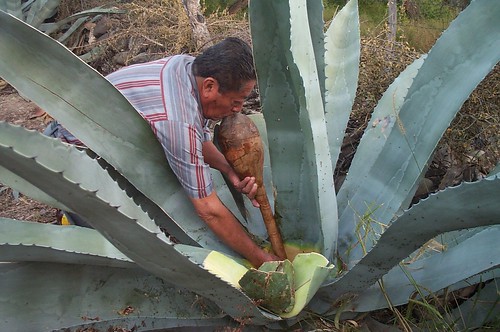
Pulque is harvested from the maguey cactus. The heart of the plant is cut and scraped out to form a well. Over the course of a few days the liquid contained within the plant's thick, succulent leaves begins to drain into this well. The liquid is then collected, much in the same way as it has since antiquity, and stored in large steel tanks and allowed to ferment. A film that does a good job in documenting the process is entitled, Que Viva Mexico!

I wouldn't be surprised if in the not too distant future you see pulque, which is also typically flavored with a variety of natural fruit juices, appearing on the menus of some of the more trendy restaurants around town. Until then, you can read about how pulque figures into ancient Aztec mythology as well as its culinary use.

Books:
El Maguey y el Pulque en los Codices Mexicanos
Tequila! : Cooking with the Spirit of Mexico

Web:
Mexico Cooks - Excellent blog posting on the subject


Brewing beer at home:
How to Brew: Ingredients, Methods, Recipes, and Equipment for Brewing Beer at Home
The Everything Beer Book: Everything You Need to Know to Buy and Enjoy the Best Beers, Even Brew Your Own


Home wine making:
From Vines to Wine: The Complete Guide to Growing Grapes and Making Your Own Wine
Winemaking: Recipes, Equipment, and Techniques for Making Wine at Home