Friday, August 06, 2010

Kashmir - Paradise Shattered


Kashmir has been in the news a lot lately – the political unrest and the flooding, Kashmir, which was the inspiration for James Hilton’s Shangri-La in Lost Horizon ,was created as a result of the Indian Independence Act of 1947. Kashmir's political problems date back to the 1947 partition, when Pakistan was carved out as a home for Indian Muslims. Kashmir was divided -- and remains divided -- between the two countries. India claims that Muslim-dominated Kashmir is an integral part of the country. Pakistan sees Kashmir as simply an unfinished task of partition. Most Kashmiris would like to be left alone by both sides. Sixty percent of its roughly 10 million residents are Muslim, the remaining 40 percent are Hindu. Estimates vary, but anywhere from 50,000 to 100,000 people have been killed during the conflict. Both sides have committed widespread human rights abuses, creating an environment of fear and distrust.

In the 2005 novel that's set in Kashmir, Shalimar the Clown, by Salman Rushdie, the author's epigraph is “a plague on the both their houses”, referring to India and Pakistan. Salman Rushdie's grandparents, on his mother's side, were born and raised in Kashmir. He and his siblings spent their summers there. To Rushdi, Kashmir is paradise on earth, with its unique combination of intense physical beauty - lush valleys, majestic Himalayas - and a history of tolerance among Hindi,, Muslim and Sikh. But India and Pakistan have trampled over this culture of tolerance. Shalimar the Clown is a tragic love story between a Muslim and Hindi, and a history of Kashmir. A claustrophobic marriage causes a young woman to leave her husband, which begins the transformation of a gentle young man into a ruthless murderer, but the tragedy of Kashmir also contributes to his downfall. The Library has over 20 copies of the book, with just one copy checked out, so there are plenty to go around.

Wednesday, August 04, 2010

Harold Lloyd


I know you might be a big fan of Charles Chaplin or Buster Keaton, and you might think that they are the best silent movies actors. I, on the other hand, think that the best, the most creative and charismatic, was Harold Lloyd - sorry for disagreeing!

His character, a guy wearing a straw hat and horn-rimmed glasses, was a vivid representation of a man from that period of time. He wasn’t a super hero, or a tramp, he was just a man going through life with confidence and a very optimistic attitude. Most of his movies show important innovations on the use of the camera. An example is the famous scene of him hanging from a clock high up in a tower. With a good angle from the camera, he makes us cringe in our seats with a feeling of vertigo, making us believe there was nothing under his feet. This scene was very dangerous to shoot since he was so close to the edge of the building's roof where he was standing, but he kept on going with the shooting, as he did with many other dangerous scenes in his movies. He did all of his own stunts. He also used a test audience to preview his movies to see which parts were good, which ones needed to be redone, and then tested them again, a technique not used by others at that time.

His film Girl Shy is considered the first romantic comedy in the history of film, and his movie Safety Last is considered by the American Film Institute as one of the 100 most thrilling movies. So, if you are ready for the adventure of watching his movies, Austin Public Library can help you with that:

Monday, August 02, 2010

Moss Hart

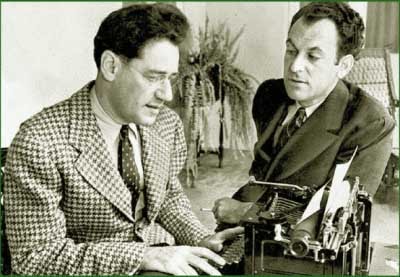
George S. Kaufman and Moss Hart

It's probably not a good idea to confess this on my employer's blog, but now and then I call in late so I can finish a book. It doesn't happen often. Even with the welter of books published these days, one that I literally cannot put down is rare. But I found one the other day, and I couldn't get to the end in time for work, so I called in late. I had to finish Moss Hart's autobiography, Act One.

Hart wrote and/or directed You Can't Take it with You, The Man Who Came to Dinner, A Star is Born, and My Fair Lady, but you won't hear much about those smashing successes in his book. Act One is about Hart's early years and his struggle out of poverty; about his working without food, sleep, encouragement, and sometimes pay, until he'd made a place for himself in New York theater.

Hart spent summers at holiday camps in the Catskills working as a social director so that he could spend winters writing plays. Six winters, six plays, six rejections. As the seventh winter began, taking up his regular writing spot on the beach (it was quieter than his parents' house in the Bronx), Hart shuffled through last winter's rejection slips. On one of them was written some advice: the funny parts are good; why don't you try comedy?

The second half of Act One is the story of the herculean work that went into writing, selling, and staging that comedy, the Kaufman/Hart play Once in a Lifetime. Hart tells how the play evolves, from first draft through rewrites, through out-of-town runs and rewrites, through hope and despair and more rewrites, and failure and rewrites and another chance and rewrites and last-minute rewrites, to opening night on Broadway.


The story is as funny, entertaining, and suspenseful as any I've read, and Hart has important things to say about hard work and perserverance and luck. A well-written book about showbiz is a rare thing. The critics loved Act One when it came out in 1959 and it holds up today. If you liked Russell Baker's Growing Up, put Moss Hart's Act One on your reading list.

Kitty: An Autobiography by Kitty Carlisle Hart (Mrs. Moss)

Friday, July 30, 2010

Alice

I recently re-read Alice in Wonderland and Through the Looking Glass by Lewis Carroll and it helped me remember how in love with this fairy tale I was as a child. The idea of slipping off into a world that you could freely explore where nothing was as it seemed very much appealed to my young imagination. As evidenced by the numerous book and movie adaptations and spin-offs, it obviously appeals to many people. I think a few things contribute to its appeal: the novelty of the nonsense world Carroll created, seeing everything from the unique child-like perspective of Alice herself, and an element of horror always in the background and sometimes center stage. But there's more to it than that. A poet W.H. Auden said of Alice:

"...one of the most important and powerful characters is not a person but the English language. Alice, who had hitherto supposed that words were passive objects, discovers that they have a life and will of their own. When she tries to remember poems she has learned, new lines come into her head unbidden and, when she thinks she knows what a word means, it turns out to mean something else."

I couldn't agree more. Carroll's nonsense verse and plays on words are one of the reasons I have re-read this book several times!

You can indulge your love of all things Alice at the library. We have the originals, the adaptations, and the spin-offs. Here's a sampling:

BOOKS

Alice I Have Been: A Novel
Alice Lidell, who Alice in Alice in Wonderland is based on, is the protagonist in this well-reviewed novel.

The Alice in Wonderland Cookbook: A Culinary Diversion

Alice's Adventures in Wonderland and Through the Looking Glass
Carroll's original two books about Alice and Wonderland - this edition includes the original illustrations by John Tenniel.

The Annotated Alice
Includes both Alice and Looking Glass w/ Tenniel's illustrations and annotations by Martin Gardner, an expert on Carroll and Alice.

The Looking Glass Wars
Great YA and up spin-off on Wonderland - this is the first in a trilogy that includes Seeing Redd and ArchEnemy. If you like these books, you might also try the graphic novels based on them, Hatter M.

The Mystery of Lewis Carroll: Discovering the Whimsical, Thoughtful and Sometimes Lonely Man who Created Alice in Wonderland

MOVIES

Alice
TV mini-series spin-off with a grown-up Alice revisiting a changed Wonderland. Kathy Bates stars as the Queen of Hearts.

Alice in Wonderland
Spin-off directed by Tim Burton starring Johnny Depp

Alice in Wonderland
Walt Disney's animated adaptation

Lewis Carroll's Alice in Wonderland
1933 adaptation featuring Cary Grant, W. C. Fields, and others

Wednesday, July 28, 2010

Ah!! Bel Canto!


On Sunday afternoons, my grandpa will close the door of his room, lie down in bed, and listen to the opera radio show. I grew up listening to this type of music (some snoring included in the background.) It was very simple; no one told me I had to like it or taught me about the most relevant exponents of it or its history. I just learned to love it because of him.

It is when I started reading more about it that the topic gets more complicated but not less interesting. I learned that Singspiel, semi-opera, operetta and opera comique are some of the different types of operas. Each one defined by the plot and the combination of spoken dialogue, music, or dancing roles. I learned also that Jacopo Peri, an Italian composer and singer, is the author of Dafne, known as the first work considered an opera, played around the year 1597. Claudio Monteverdi, another Italian composer is also considered one of the pioneers of this type of music, and his opera titled L’Orfeo that was first played in 1607 is still performed nowadays.

Despite the fact that this music style is more than 500 years old, opera is still popular today. Francesco Cavalli, Rossini, Bellini, Verdi and Donizetti, are some of the most important exponents of this genre that I am sure you’ve heard about. Arias like “La donna è mobile,” “Nessum dorma, ” and “O sole mio” are now pretty much everywhere, from TV ads to music boxes. During the 90s José Carreras, Luciano Pavarotti, and Plácido Domingo captured the attention of millions with their famous tours and concerts around the world. Currently, bands with different music styles, like East Village Opera Company does interesting covers of famous arias that you might enjoy.

Some books about the topic you could check out are:

Monday, July 26, 2010

Oenophilia*

These days wine is made all over the world, but 34 years ago fine wine was presumed to come only from France. And then, on a spring day, somebody held a little contest in a Paris hotel...

In 1976, as part of the French celebration of the U.S. bicentennial, Stephen Spurrier, the British owner of a Paris wine shop, conceived an event he thought would pique interest in French wines and maybe prove them superior once and for all: a blind taste test. France v. California. Bring on the snobs, er... wine tasters.

Guess who took first place. It is a competition so famous (if you're French, infamous) oenophiles commemorate it as the "Judgment of Paris". At first the French ignored the results, then they waved them away as subjective and statistically insignificant, then they insisted that French wines age better. So 30 years later the tasting was restaged, the old bottles dusted off, the judges back for another try. Guess who won again.

Why Hollywood took so long to turn this Cinderella story into a movie I do not know, but now there are two. Unless you're an Alan Rickman fan, don't bother with the first film, Bottle Shock (2009). Instead, bide your time watching Sideways (2005), and cross your fingers that the second movie about the taste test, Judgment of Paris, due out this year, tells the story with the piquancy it deserves.

The winning cabernet is for sale online, and the chardonnay was just auctioned to raise money for Haiti. If you can't spend $2000 on wine, enjoy this sour grape: in 2006 Forbes judged the chardonnay past its prime. (Have a look at both bottles on exhibit at the National Museum of American History at the Smithsonian.)

Books to sip wine by:

Judgment of Paris by George Taber
Academie du Vin Complete Wine Course by Stephen Spurrier
Wine Appreciation by Richard Vine
The Pocket Wine Book
by Hugh Johnson

* pronounced ee-no-FEEL-ya

Friday, July 23, 2010

Mad Men


The cult TV hit Mad Men enters its 4th season this Sunday night. The Library has a book coming soon for the show’s many devoted viewers - Mad Men Unbuttoned: A Romp through 1960s America by Natasha Vargas-Cooper.

The author is an enthusiastic fan of Mad Men (she operates a
Web site with the same name as the book). She uses the show, about advertising executives in the 1960s, as sort of a portal into the decade, which was the golden age of Madison Avenue - a time when chain-smoking was in, gender equality was out, and the talk was as smooth as the three martinis at lunch. She discusses some real-life advertising giants (Ogilvy, Burnett, Daniels), talks about social mores (particularly sex), and discusses early 60s books, movies and music. But as one TV critic said, "No matter how many iconic shots there are of Don Draper taking a drink or having a smoke, or how the wardrobe looks or who made the office furniture, there's only one overriding theme in Mad Men: identity."(www.sfgate.com)

If you haven’t watched the show, or need to catch-up, the Austin Public Library owns season one, two, and three. If you would like read novels of that era, try a book off one of the following lists:

Recommended Reads:

Bullet Park by John Cheever
The Learners by Chip Kidd
The Man in the Gray Flannel Suit by Sloan Wilson
On Chesil Beach by Ian McKewan
Rabbit, Run by John Updike
Revolutionary Road Richard Yates
When All is Said and Done by Robert Hill

Books the characters have been seen reading on the series:

The Agony and the Ecstasy by Irving Stone
Exodus by Leon Uris
The Group by Mary McCarthy
The Sound and the Fury by William Faulkner
Lady Chatterly’s Lover by DH Lawrence
Ship of Fools by Katherine Anne Porter


Wednesday, July 21, 2010

Are you prone to peek??


 I cannot understand the why or the philosophy behind peeking at the end of a book you are reading. I guess I am what you would call a “linear reader,” which simply means that I read a book from beginning to end; I don’t read the beginning of the next chapter, or skip pages, or read the beginning of the last chapter or the last sentence of the book. Nope! I just love the idea of being surprised by the end of the book. I like seeing how the plot evolves and changes and how the writer takes you to unexpected places or situations. I like to see the process as it happens while you read the book in its original order. But, if we are talking about poetry books, magazines or newspapers, well, I am all over the place - not “linear” at all! Some people read their newspapers or magazines back to front and others only read certain sections of them. Some others peek depending on the genre: romance, yes, but never mysteries.

The more I talk to people about the way they read, the more I learn about all the interesting things they do. A friend told me that he knows his favorite author often has a character in his books that has a great heart, great personality and is just a very good, nice person. But this is the person that often gets killed at the end. So, my friend stops one or two chapters before the ending and creates his own where the nice character continues alive and well. Interesting don’t you think??

Rereading is another thing I don’t ever consider, but people often do. They have a selection of books that they reread every couple of years or so, and in some cases, they even mark sentences or phrases with different colors, one for each year, so they can see what was important to them at a certain point in time.

At the end, no matter what you do, just enjoy your reading!! If you are looking for something to read during this summer, don't forget about our Good Reads page with tons of good information and ideas on what to read next. Have fun!

Monday, July 19, 2010

Mountain Music


I tremble to say so in Texas, but I don't care much for country music. Of course I like Willie and the Dixie Chicks, and I like a couple of the really big hits like "Stand by Your Man" and "Crazy" and... um... that might be it. I'm a Yankee.

So imagine my surprise in 2000 when, after seeing the Coen brothers' old-timey country-music fest O Brother, Where Art Thou?, I found myself driving straight to Waterloo Records to buy the soundtrack.

The album's popularity also surprised Dr. Ralph Stanley, the 70-year-old musician featured on O Brother. He and his brother Carter had had some success after World War II as the Stanley Brothers and the Clinch Mountain Boys--they'd had some flush times and made records for a national audience--but they'd never hit it really big like Lester Flatt and Earl Scruggs. Even I had heard of Flatt and Scruggs, but until O Brother, I had never heard of Ralph and Carter Stanley.

Dr. Stanley has written a wonderful book (with Eddie Dean) about being a kid in Appalachia and learning music handed down through generations; about writing songs in the car speeding down a dark road to a play date, arguing with promoters, dealing with troublesome band members, finding musicians whose talents blend into the sound he wants, and what happened to his career when Elvis sang "Blue Moon of Kentucky". He talks about losing loved ones and staying true to the old-time music and winning a Grammy at age 70 for his rendition of "O Death" in O Brother.


Man of Constant Sorrow: The Life and Times of a Music Legend recounts 82 years of writing and playing mountain music, but you don't have to be a fan of the music to admire the book. Dr. Stanley would understand, I think. After all, he doesn't care much for rock and roll.

Friday, July 16, 2010

Alarm Bells

I’m reading a fantastic yet utterly frightening book right now called Eaarth by Bill McKibben. McKibben was one of the first to write a book about climate change geared toward a general audience, called The End of Nature, and he has written several books since, Eaarth being his most recent. The book is titled Eaarth because this is the new name McKibben has assigned to the new planet on which we live – one where natural resources are becoming scarcer, the climate is changing surprisingly rapidly, and the level of carbon dioxide in the atmosphere is higher (392 ppm) than the level deemed safe for humanity by scientists (350 ppm; see this webpage for more information). He informs us that we have altered our old planet in so dramatic a way that many of the rules that once applied to it no longer do. To further exacerbate this, our country, at least, but really the entire planet has been pursuing growth and planning for growth continuously. Considering we do not live on the old planet we used to, we will not have the resources, such as oil and water, to sustain growth. In fact, there is much evidence that we soon will not have the natural resources to support ourselves at current capacity.

McKibben spends the end of the book trying to work out how we might live on this new planet we’ve created through global warming and exhaustion of resources. Largely, it’s a sort of get local, do it yourself message. He doesn’t believe there is anything we can do to get back to our old planet, but he does believe that we can exist on the new planet if we start learning to produce things for ourselves. For example, if I’m capable of producing my own food, then the poor yield on wheat and/or the lack of any fish in the ocean for fisheries to catch and provide to my supermarket won’t affect me as much. McKibben calls for governments and people to rid themselves of an expansionist, global point of view and get back to basics. Bigger is not better. In fact, bigger is ruining our chances at surviving on this so-called Eaarth.

It would be easy for me to get in far more detail here as the book makes many interesting points and is heavily researched with excellent notes. But I’ll leave it to you to pursue along with all of the other great resources we have to help connect you with the information you need!

BOOKS

Deep Economy: The Wealth of Communities and the Durable Future

Eaarth: Making a Life on a Tough New Planet

Permaculture: Principles & Pathways Beyond Sustainability

State of the World 2009: Into a Warming World: A WorldWatch Institute Report on Progress Toward a Sustainable Society

WEBSITES and ARTICLES

350.org
Founded and lead by Bill McKibben 350.org is "an international campaign that's building a movement to unite the world around solutions to the climate crisis - the solutions that science and justice demand. Our mission is to inspire the world to rise to the challenge of the climate crisis — to create a new sense of urgency and of possibility for our planet."

Artic is Melting Even in Winter

Bill McKibben discusses Eaarth (a podcast)

Climate Changing ‘Faster, Stronger, Sooner’

Climate Warming Means Food Shortages, Study Warns

The End of Car Culture*
*Requires an APL card to access from home

Wednesday, July 14, 2010

Gossip!

It might cheer Sandra Bullock, who recently divorced a cad, to know that it could have been worse. She might have married a man like Andrew Robinson Stoney (1747-1810) who duped one of the smartest, richest, most beautiful women in the world into marrying him, then spent her fortune, ransacked her estates, alienated her children, held her prisoner, cheated with any woman who would have him (and raped some who would not), and beat and starved her until she ran for her life. The marriage was the subject of a play (School for Scandal), and a novel (Barry Lyndon), and the divorce kept British courts busy for years (Bleak House). Dissolving the Bowes-Stoney union in 1789 changed laws that had governed marriage in Britain since 1536, the year Henry VIII chopped off Anne Boleyn’s head.


Wendy Moore has written a page turner about the scandal: Wedlock: The True Story of the Disastrous Marriage and Remarkable Divorce of Mary Eleanor Bowes, Countess of Strathmore. It's history; it's gossip; and in spite of passages of savage abuse, it's a lot of fun. It's Pride and Prejudice II: The Revenge of Wickham.

(If you'd like to read a transcript of the trial, ask for it through interlibrary loan.)

Monday, July 12, 2010

Jovita Gonzalez

A very large part of what makes Texas interesting to me is its proximity to Mexico. Even in the state's capital, it is very easy to see, touch, and taste the influence of Mexican culture. I walk around town with a feeling that this isn't quite the U.S. and it isn't quite Mexico. This sentiment is exponentially magnified the closer one gets to the border. So much so, that many of the border towns, albeit divided geographically, exist as one culturally, economically, and metaphysically. Almost 80 years ago, Jovita Gonzalez chronicled this interconnectedness in her master's thesis, Life Along the Border: A Landmark Tejana Thesis. Read it, and gain a deeper understanding and appreciation for what makes this part of Texas distinctive and special.

Fiction written by Jovita Gonzalez:
Caballero: A Historical Novel
Dew on the Thorn
The Woman Who Lost Her Soul

Friday, July 09, 2010

Contemporary Culture Humor

Creative people of all types use the Library: authors researching historical facts, artists looking for photographs, or musicians looking for unique recordings. I recently helped a local stand-up comedian look for authors similar to David Sedaris, an author who writes about himself, his family, and contemporary culture with sardonic wit and incisive social critiques. Books by such authors do not share the same subject heading, so a list was created for Good Reads titled Contemporary Culture Humor. The title is a little awkward, but it describes the content.

The newest book on the list is Talking to Girls About Duran Duran: One Young Man's Quest for True Love and a Cooler Haircut by Rob Sheffield. Rob Sheffield has been a music journalist for more than twenty years. He is a contributing editor at Rolling Stone, where he writes about music, TV, and pop culture. He is the author of the national bestseller Love is a Mix Tape, a memoir of love and music. Chuck Klosterman, another author on the list, said this about Rob's newest book:

A handful of rock writers can explain what they think about music, and lots of rock writers can explain what they feel about music. What makes Rob Sheffield different is that he nderstands how those feelings are generated. He can turn those abstract emotions into concrete thoughts. It doesn't happen often, but sometimes the smartest guy in the room is also the funniest guy in the room...and the nicest guy...and the tallest guy...and the most vocal Chaka Khan fan.

Wednesday, July 07, 2010

Don’t kill them!! They are good!!!


They might not look very pretty and they might be eating the leaves of some of your flowers and crops, but before you grab that pesticide, please double check if they are actually beneficial insects that can help in your yard.

Some beneficial insects are lucky because they already look quite cute, like in the case of butterflies and ladybugs. So even when people don’t know how good they are in their gardens, they are less prone to kill them. Others like the Assassin Bug, damsel bugs, and minute pirate bugs are pretty much out of luck since their appearance usually scares anyone, they are not as well known as the mantis and the bees, and they also look like the insect that spreads the Chagas disease.

I always connect the word “nematode” with “human parasite,” but something I’ve learned recently is that there are beneficial nematodes too. They live in your garden soil and eat the larva of some of the insects that are considered the worst pests. So, next time I dig in my yard, I will make sure I don’t kill those either.

How do you know what is good and what is not?? Well, Austin Public Library can help you with that. We have some titles that can guide you through like:

The Grow Green program of City of Austin also has some information on beneficial insects and you might want to visit the Association of Natural Bio control Producers as well.

Sunday, July 04, 2010

Happy Fourth!


Your library is closed today to celebrate American independence, but your card number will still get you into our online databases where you can commemorate the fourth by reading American history, or biographies of the founders, or trace your ancestors back to the Mayflower with the help of the geneaology databases, or scan magazine articles about the day, or any day... or any thing, what the heck? You're on holiday! Read whatever you want!

Here's a fun web site from Uncle Sam that answers every question you've ever asked about the Fourth of July. Here's Sam again with the Declaration of Independence with zoomable photos of the original, and here's Snopes on the fates of its signers.

Notice I did not link to a web site listing the ingredients in hot dogs. You're welcome.

Friday, July 02, 2010

"I'm sick and tired of being sick and tired."

If I had stopped with my public school education, my impression of the Civil Rights Movement would be that it was largely led and coordinated by males, particularly Dr. Martin Luther King, Jr. I know now, however, that African-American women had a huge influence on and played an essential role in the Movement. There are a number of women that stand out, such as Septima Clark and Ella Baker, but a particularly fascinating and influential woman that I read about in college is Fannie Lou Hamer.

Hamer was born in 1917 and lived all of her life in the Mississippi Delta, a particularly harsh place for African-Americans to live during this time period due to widespread poverty and white racism and oppression. She was the daughter of sharecroppers and starting at a very young age helped her family by picking cotton. Hamer lived in extreme poverty most of her life, had a limited education, and experienced first hand many of the hardships that were suffered by African-Americans in the Delta.

But it wasn't until about middle age that Hamer became active in the Civil Rights Movement. The Student Nonviolent Coordinating Committee (SNCC) held a meeting at a church near her home in 1962. It wasn't until this time that she knew that African-Americans had the right to vote. She vowed to get registered and began encouraging others to do the same. Like a good majority of African-Americans trying to get registered to vote, she faced significant obstacles including a test (obscure questions from the Mississippi Constitution, which she failed twice), poll taxes, and harassment by city and state officials and white citizens.

Hamer became a field secretary with SNCC organizing voter registration drives and developing programs to help economically disadvantaged African Americans. Due to her role and activism she faced beatings, a particularly brutal one after being imprisoned for entering a whites-only bus station restaurant to eat, continuous threats and ridicule, and even a bombing. Despite it all, Hamer persisted and was one of the founding members of the Mississippi Freedom Democratic Party (MFDP) in 1964 created to challenge Mississippi's all-white delegation to the Democratic National Convention. It was here at the DNC that Hamer made a famous televised speech in which she asks, "Is this America, the land of the free and the home of the brave, where we are threatened daily because we want to live as decent human beings?" This speech is at least partly responsible for the passage of the 1965 Voting Rights Act that made it illegal to deny any U.S. citizen the right to vote. (Listen to the speech or read the transcript.)

Hamer remained politically active until her death in 1977 and helped found a number of cooperatives including the Freedom Farm Cooperative, "a project through which 5,000 people came to grow their own food and collectively own 680 acres of land." Her achievements and activism are no doubt remarkable, but it was also Hamer herself - a female, uneducated, middle aged, sharecropper - that breaks the mold when we consider the persistent view of the Civil Rights Movement as having been lead by male, articulate, educated, religious and/or student leaders. In fact, it is precisely her position as none of those things that made her the effective, beloved activist she was.

There are many amazing memoirs and biographies out there about female African American civil rights workers and activists. Come down to the library and pick one up (or place a hold!), or browse the links below to learn more about Fannie Lou Hamer.

BIOGRAPHICAL ESSAYS
All quotes come from the biographical essays that may be accessed via APL's Biography Resource Center database w/ your library card number.

BOOKS

Coming of Age in Mississippi by Anne Moody
A famous memoir about Moody's life growing up poor and Black in Mississippi. In her college years she became active in SNCC and CORE (Congress of Racial Equality).

Ella Baker and the Black Freedom Movement: A Radical Democratic Vision

For Freedom's Sake: The Life of Fannie Lou Hamer

Freedom's Daughters: The Unsung Heroines of the Civil Rights Movement from 1830 to 1970

From the Mississippi Delta: A Memoir
by Endesha Ida Mae Holland
A story of a woman also from the Mississippi Delta and active in SNCC after her younger years were spent in and out of prison and prostitution.

Open Wide the Freedom Gates: A Memoir
by Dorothy Height
Height was a well-known activist and president of the National Council of Negro Women.

Ready From Within: Septima Clark and the Civil Rights Movement by Septima Clark
Clark seems relatively unknown to most, but she was a key person in the Civil Rights Movement believing education was essential to political empowerment. She founded numerous "citizenship schools" in which African Americans were taught literacy and organized to get them registered to vote - a concept that spread throughout the U.S. and is considered responsible for getting thousands of African Americans registered.

This Little Light of Mine: The Life of Fannie Lou Hamer


SONGS/AUDIO
Fannie Lou Hamer was known for her singing of gospel music at rallies, protests, and marches. It was common to hear a lot of gospel music at events like this, but it has been remarked that Hamer had a particular gift for bringing people together in song: according to Julian Bond, "She sang. She led freedom songs. She didn't have a perfect voice, but she could make you want to sing, make you want to join with her."

Singing Go Tell It On the Mountain

Singing Wade in the Water

Sing for Freedom: The Story of the Civil Rights Movement Through Its Songs

WEBSITES

An Oral History With Fannie Lou Hamer

Includes the audio file and complete transcript

Fannie Lou Hamer on the roots of her activism

Wednesday, June 30, 2010

Gay Pride Month Book Lists

June is Gay and Lesbian Pride Month. The first U.S. gay pride parade called “Christopher Street Liberation Day” took place on June 28, 1970 in New York. The parade covered fifty-one blocks. Since then, June has been considered Gay Pride Month, and in 2000, it was officially recognized by President Clinton, who named it “Gay and Lesbian Pride Month.” President Obama made the month’s name more inclusive on May 28th of this year, naming June Lesbian, Gay, Bisexual, and Transgender Pride Month.

The Publishing Triangle, whose mission is to promote discussion between all readers gay and straight, has posted the 100 best lesbian and gay novels. I have listed my favorite books by gay authors below. You can find more books by these authors and more gay authors on APL Recommend's Gay and Lesbian Fiction: Authors and Themes .

Line of Beauty by Alan Hollinghurst
Maurice by E. M. Forster
Beauty of Men by Andrew Holleran
At Home at the End of the World by Michael Cunningham

Graphic novels have become very popular, and below are three recommended gay graphic novels.

Fun Home: A Family Tragicomic by Alsion Bechdel
Poignant memoir of growing up.

Stuck Rubber Baby by Howard Cruse
Classic coming-out story embodies America’s tipping point, when the white supremacist patriarchy got knocked off its pedestal in the 1960s.

The Authority: Relentless by Warren Ellis
A group of superheros includes three women and a gay couple.

Monday, June 28, 2010

Politics and History

No doubt politics is a weird landscape. I would venture to say the same thing about the chronicling of history. I believe that a great deal of thought and research must go into deciphering the true motives behind the perpetrators of both to gain a more objective view. This inherent weakness is made obvious in three titles that I've been thinking about recently. The first work is entitled, Last Call: The Rise and Fall of Prohibition. In it, the author discusses some of the truer motives that served as the driving force behind the passage of the Eighteenth Amendment to the Constitution. One of the biggest, fear of German and Irish immigrants, is unsurprisingly very similar to the anti-immigrant sentiment currently playing itself out in Congress. The next title is, Empire of the Summer Moon. Here, the author cites incidences of brutality that suggest, at least in the case of the Comanche Indians, they too were to blame for a great deal of the blood-letting and atrocities that occurred in much of the middle of the country during the settlement of the West. Lastly is the juggernaut, A People's History of the United States, 1492 - Present. It is easy to gain a sense of the author's bias and political leanings reading this work. However, it does introduce ideas and supporting evidence that at the very least help to form a well-rounded, plausible, and more likely view of political and historical events as opposed to the clear-cut, good against evil narrative I was accustomed to reading while in grade school.

Friday, June 25, 2010

Hat-trick

In sports, a hat-trick is when a player scores three times during a game. The term originated with cricket in the late 1870s, and meant "taking three wickets on three bowls;" then later extended to other sports, including hockey and soccer. The Library’s online database Oxford Reference Premium’s definition is “three successes of the same kind within a limited period, in particular (in soccer) the scoring of three goals in a game by one player or (in cricket) the taking of three wickets by the same bowler with successive balls”. Last week, Gonzalo Higuain of Argentina scored the first hat-trick of the World Cup against South Korea. I am watching soccer for the first time, and when I heard the term “hat trick” I racked my brain trying to remember which song I used to listen to had that phrase. Then I remembered it was from Concrete Schoolyard, by Jurassic 5.

Playground tactics no rabbit in a hat tricks
just add classic rap **** from Jurassic


Jurassic 5 was an American alternative hip hop group formed in 1993 by rappers Chali 2na, Akil, Zaakir, Mark 7even, and disc jockeys DJ Nu-Mark and Cut Chemist. Jurassic 5 made their mark in resurrecting the old-school hip-hop style made famous by veterans such as Grand Master Flash, Melle Mel and Run DMC in the 1980s. The group broke up in 2007 after nearly 15 years together. Classic Jurassic 5 tunes include Concrete School Yard, Quality Control and The Thin Line.

Jurassic 5 albums at APL:

Feedback
Power in Numbers
Quality Control

To find other hip hop cds at APL, type hip hop in the FindIt search box, and then choose music on cd in the drop down menu.

Wednesday, June 23, 2010

Ooooooe oe oe oeeeeeeeeeeeeeeee!!!


OH YES!!! It’s here! It’s happening right now!!! The World Cup is finally here!!! The language shared by soccer fans around the world include the words - corner kick, free kick, fault, penalty, own goal, goal, and yellow and red cards. People from so many different countries speak the same language, the language of a great sport (I know a lot of you might disagree, but it’s ok.) Soccer, because of its simplicity, and the fact that it doesn’t require any special equipment to play, is one of the sports followed by millions of fans around the globe. You only need a ball of some sort (sometimes you can even make one with plastic bags if nothing else available) and another person who would like to play and you are all set. Of course there are more fancy camps and teams for training kids, teens and adults, but sometimes the best match is the one that you play with your friends in a park at the end of the afternoon.

But the culture of soccer goes beyond the sport itself. As the Roman poet Juvenal said: “bread and circuses,” a saying often linked to soccer because of the sport’s power to distract citizens from important governmental decisions that go on while the population is paying attention to big games.

Every four years, since 1930, the best teams in the world get together and for a month they fight to reach the finals and have a chance to win the tournament. The first World Cup was played in Uruguay, at the “Estadio Centenario,”  that carries the title of “Historic Monument of World Soccer.” Uruguay was also the country that won the first World Cup ever.

Many years have passed and currently the countries that have won this tournament more than once are:

Brazil: five times
Italy: four times
Germany: three times
Uruguay and Argentina: two times

Who do you think will win???
Hey!!
Here comes the wave!

„¸¸„ø¤º°¨Soccer¸„ø¤º°¨¨°º¤øº¤øSoccer„¸¸„ø¤º°¨¨°º¤øº¤øSoccer„¸¸„ø¤º°¨Soccer¸„ø¤º°¨¨°º¤Soccerº¤ø„¸¸„ø¤º°°º¤øº¤ø Soccer„¸¸„ø¤º°¨Soccer¸„ø¤º°¨ ¨°º¤øº¤øSoccer „¸¸„ø¤º°¨¨°º¤øº¤ø Pass it on!

Some books for your enjoyment are:

For more information and highlights about the games you can go to the FIFA website.

Monday, June 21, 2010

Backyard Birds of Texas

I spy on my neighbors with binoculars. I watch their most intimate behavior: eating, conversing, bathing, even (ahem) procreating. I spend some time each day at it, and I admit, I enjoy it. Right now there are two couples in particular I've got my eye on. They live in houses hanging from the branches of my oak trees. One is a pair of wrens and the other house sparrows.

The wrens are natives, but the sparrows are invaders from Europe that are overrunning native species. For years sparrows lived in a large colony under my neighbor's siding until he finally plugged the openings with foam. Now that the sparrows can't get into their condos, there are fewer of them and more native birds in my yard: more cardinals and jays and titmice and grackles. (Did you know a grackle is a songbird?)

Texas is the state for watching birds, and APL has the books to help you identify them. My favorite is this one:

(The author's name can't possibly be pronounced tweetin'... you think?)

Books for the birds in Texas:
Finding Birds on the Great Texas Coastal Birding Trail
Bird Witched
(by a long-time Austin Public Library patron)
Birding the Southwestern National Parks

Friday, June 18, 2010

An Inspired Move

Moving is often a long, exhausting process. What you hope to unpack in a week is still in boxes two weeks later. If you're like me, you get to a breaking point where all items must be deemed absolutely essential in order to make it into a box and not the dumpster. Moving is the perfect time to downsize.

Despite the exhaustion and heavy lifting, moving brings you to a new place with new possibilities (even if those possibilities are only decorative). You can pretend you will be cleaner and more organized in you new place. You can make big plans to paint, build furniture, get some nice plants for the patio. A new place is like a blank slate ready for you to put your mark on it.

The nonfiction section at your local public library is a dream for anyone looking for moving advice, downsizing and organizing tips, basic home upkeep, and, of course, a huge assortment of books on decorating your home, from DIY, crafty projects to landscape design. Ever browsed the Faulk Central Library's 3rd floor? The entire floor is nonfiction and our selection is huge. I can't think of a better place to get inspired and help you make your new (or old) home yours.

Can't find the books you're looking for? Ask a Librarian! We use FindIt, the online catalog, all the time and know the tips and tricks to get you what you need.

BOOKS

Downsizing Your Home With Style: Living Well in a Smaller Space

Home Décor Sewing Techniques Bible


Home Outside: Creating the Landscape You Love


The House Always Wins: Creating the Home You Love-- Without Bursting Your Budget

How to Survive a Move

Martha Stewart's Homekeeping Handbook: The Essential Guide to Caring for Everything in Your Home

Moving With Kids: 25 Ways to Ease Your Family's Transition to a New Home

Throw Out Fifty Things: Clear the Clutter, Find Your Life

Wary Meyers' Tossed & Found: Unconventional Design From Cast-Offs


MAGAZINES
Stop by the 2nd floor of the Faulk Central Library to browse these and many other great magazines.

Dwell

Home Power

ReadyMade

WEBSITES/BLOGS

Apartment Therapy


Decor8

Design Sponge

Desire to Inspire

DIY Network

Oh Joy!

Tipnut

Wednesday, June 16, 2010

500 YEARS!

That’s how long microfilm lasts. (You wouldn’t have read any farther if the title of this post had been MICROFICHE! now would you?) Of course that’s just an estimate; we've been storing information on film to save space only since the 1800s. Disks—including hard drives—degrade from use, temperature, and development of new storage technologies (How many floppies did you toss without checking to see what was on them once you’d learned how to burn disks? How many files did you leave on your hard drive when you handed your old computer over to Goodwill?), but microfilm is less delicate and stores information in language readable by anybody with a magnifying glass.

Work not typed into computers, that is, work done on paper, that is, almost everything written before 1985, is saved for space on microfilm, if it's been saved. (Although information manipulation companies are digitizing as fast as they can.) That’s why you’ll find extensive microfiche files and microfilm readers and printers on the second floor of the downtown library.

To see APL's holdings of periodicals--including microfilm holdings--from our home page, click

--> research tools
--> periodicals
--> Faulk Central Library Periodicals Search

then enter the title of a periodical, or use the browsing links. (Here's an example of an end result: New York Times Book Review.) Have your library card number handy; we've linked to our digitized holdings of the Book Review on that same page.

If you'd like to read more about long-term information storage, here's a link to a related APL post: The Future of the Book.

Monday, June 14, 2010

The Birth (and Death) of the Cool

I was originally attracted to the title, The Birth (and Death) of the Cool, because the Miles Davis recording, "The Birth of the Cool", is truly one of my top ten favorite music recordings of all time. I believe that all great art transcends time and remains fresh and relevant irrespective of when it was made. That being said, the subject matter of this book traces the invention and subsequent iterations of what it has meant to be considered cool throughout the decades from a semi-sociological point of view. It examines the concept's origins and subsequent co-opting by marketing departments and advertising agencies who harnessed, and continue to harness, it's societal cache in the hopes of selling products to highly segmented and targeted consumers. Believe it or not, but there was once a time when being considered cool or hip was all in one's attitude. It wasn't until much later that coolness was artificially defined based upon on the objects one was surrounded by or the clothes one wore.

Similar titles:
Poplorica: A Popular History of the Fads, Mavericks, Inventions, and Lore That Shaped Modern America
American Culture, American Tastes: Social Change and the Twentieth Century
Teenage Nervous Breakdown: Music and Politics in the Post-Elvis Age
Retro Hell: Life in the '70s and '80s, From Afros to Zotz

Friday, June 11, 2010

Exactitude


The very popular Outliers by Malcom Gladwell focuses on what makes some people become succesful, and one factor is how hard you parctice or work to develop your talent. A new art book at the Library illustrates this drive to create something perfect with one's talent. Exactitude, Hyperrealist Art Today is an imaginative and original book which presents a selection of contemporary artists, most of whom are represented by Plus One Gallery , working in a figurative, hyperrealist style. In the foreward, Clive Head, one of the artists, says:

"The paintings are made with remarkable care. To invest such care into the paining of an object. figure or landscape, is indicative of a compulsion to serve an ideal...We have moved on from mere picture making to a quest to reveal how the world should be through the meticulous rendering of a subject, irrespective of how arduous a task may be.

Talent is always rare and the conviction and dedication to nuture that talent will always make masterful works of art a very infrequent occurrence."


The works range from still lifes and extreme close-ups to large scale cityscapes and landscape paintings. All the work celebrates the meticulous fashion of photorealism. But in these paintings photorealism has moved from the slum and garbage dump - it can now be beautiful. The hyperealist art movement has moved one step from photorealism since the artist attempts to reinterpret or modify the photograph to create a false reality, an enhanced illusion, using brighter colors. Some artists digitize dozens of photographic images for each picture, composing, collaging, warping, and colourizing on the computer before returning to the canvas and paint. Some artists use photography alongside sketching and observation, to know the subject and to analyze it. But the result is the same - the paintings are breathtaking, and there are over 500 color images in the book.

Wednesday, June 09, 2010

Covered with Romance


I have to admit that romance is not my favorite genre. Not knowing what is at the end of the books I read is one of the things that interest me and this is not the case when we talk about romance. A book classified under this category HAS to have a happy ending; otherwise it would be considered general fiction. Something I consistently enjoy, though, is the cover art of romance books.

Longing, passion, doubt, desire, vulnerability are some of the feelings expressed to the max in these book covers. Women are usually conceived of as fragile and vulnerable while protected or seduced by a strong Alpha male. This is, I think, quite interesting since in a way it contrasts with the how women, men and relationships are conceived nowadays.

Because of the characteristics of these particular designs, the art of romance books covers is one of a kind. Most artists go through a similar creative process: they find a passage of the book they will illustrate to get inspired, then decide a time in history they will use to settle the mood of the picture and the corresponding outfits for the models depending on the historical moment, find models, a photographer, and after taking tons of pictures they can start recreating the scene that you see on the cover of your favorites romance novels.

So, next time you hold a romance novel in your hands, take your time and enjoy its cover. You might find it a little exaggerated, or you might end up identifying with the heroine or the valiant knight.  Who knows!?

Some new romance novels the library has available for you are:


Image by artist Jon Paul published with his permission

Sunday, June 06, 2010

Homeboy Industries

I always cringe whenever I hear middle class, suburban kids romanticize gang life. I don't understand the psychology behind glorifying a genuinely brutal, limited, and potentially short life. I'm certain that for these kids, whose lives are very comfortable, the sources from which they are informed present a very skewed version of reality. Fortunately, there exists a place and a person that can supply some very concrete examples of the violence and tragedy that plagues individuals who choose this path.

Father Greg Boyle has been working tirelessly in some of the roughest neighborhoods of Los Angeles for over twenty years. He started the pioneering program known as Homeboy Industries that has proven to be highly effective in transforming the lives of gang members by showing them a path to employability, education, and hope and breaking the cycle of generational membership.

You can listen to a very touching and powerful interview with Father Greg Boyle on the NPR program, Fresh Air or checkout these titles and read about this very humble man and his important work firsthand.


Related Titles:


Friday, June 04, 2010

Jeff Lemire

Jeff Lemire is a cartoonist I've recently started loving and following. His works include The Complete Essex County, The Nobody, and, more recently, Sweet Tooth (on order for the library - keep an eye out for it in FindIt!). I just finished the award-winning (an Alex award and an Eisner nomination), critically-acclaimed Essex County trilogy and it was wonderful! It is set in Essex County, Canada where Lemire himself grew up and portrays life in a rural, farm town. The sparse panels and small town characters leave an indelible impression of life in the countryside, which made me realize how rarely I come across graphic novels concerned with rural life. The first volume begins with an orphaned boy named Lester and his seemingly unlikely friendship with an outcast gas station attendant; the second focuses on the relationship between two hockey-playing brothers; and the third a charming nurse as well as the early 20th century tragedy that had an effect on most of the county's residents. The level of emotion Lemire is able to evoke from the silent panels he incorporates, the literary nature of his storylines and the way he constructs a story, and the intimacy with which you get to know Essex County's residents are just a few of the reasons you should check out either the volumes in this series or the collected edition. It has broad appeal and could easily be enjoyed by both teens and adults.

Essex County is the featured graphic novel in a *NEW* addition to APL's suggested graphic novels webpage. Every other Friday, I will be updating the webpage with a new graphic novel I've either personally read or can't stop hearing buzz about. I hope you'll take a look every few weeks, but, most importantly, I hope you find something you enjoy there!

BOOKS
The Complete Essex County
This is the entire collected series, but you can also read the three individual volumes, if you like.

Good Reads: Suggested Graphic Novels for Adults
Check here every other Friday for a new, featured graphic novel.

The Nobody
This is kind of a spin on The Invisible Man. A very enjoyable read with simple artwork that still manages to astound.

WEBSITES and ARTICLES


Wednesday, June 02, 2010

Understanding Grief


The Mourners: Tomb Sculptures from the Court of Burgandy is a touring exhibit that will open at the Dallas Art Museum in October. The mourners remind us that greiving is a collective experience, common to all people, and all moments in history. The Library has two books that offer new ways to understand grief.

The New Black: Mourning, Melancholia and Depression by Darian Leader