Wednesday, August 26, 2009

Rick Bass is good.

Discovering a new writer is special. It might be the cadence of the writing that attracts us. It might be the subject. It is often something entirely indefinable. I recently stumbled across the works of Rick Bass and am and will remain a firm fan.

I like dogs. I prefer to be outside. I like stories. Mr. Bass covers all those. He lives in rural Montana and poignantly depicts the intersection between animals and humans as well as the dual need for community and isolation. Plus, he was raised in Texas.

The Austin Public Library has a fine selection of Rick Bass’ work.

Colter: The Story of the Best Dog I Ever Had

The Wild Marsh: Four Seasons at Home in Montana

Why I Came West

The Lives of Rocks: Stories

Falling from Grace in Texas

Where the Sea Used to Be

The Sky, the Stars, the Wilderness


Monday, August 24, 2009

JOBView: Thousands of Jobs at Your Finger Tips!

The Austin Public Library has a very handy new tool for job seekers called JOBView. The database serves as an aggregator for job openings within the state of Texas as well as the rest of the country. Position descriptions can be printed, emailed, or sent to your cell phone in the form of a text message. The database will automatically route you to the employer’s or program’s website in order to apply.


Other features include:

  • Job searches can be statewide or isolated to a specific city.
  • The job radius search feature allows you to look for employment within a set distance from the center of a chosen city.
  • Search only for Hourly and Part Time positions.
  • Search for jobs in specific categories such as Accounting and Finance, Construction/Trades, Government/Military, Hospitality/Travel, Law Enforcement/Security, Non-Profit/Volunteer, Retail, Sales, etc.
  • Federal Contractors with Veteran Preference and Work in Texas positions are clearly noted.
  • A general search will list all jobs within the category as well as the employer. Click on the position’s title to see the full job description.

Friday, August 21, 2009

Shark Fiction

With summer coming to a close, and beach vacations on hold until next year, it’s now safe to read about sharks. Guys especially seem to enjoy a good shark story. And it just takes one good book to convince someone that reading can be as entertaining as watching TV. In the list below, only the Meg series is a total shark attack story like Jaws, but sharks or the fear of sharks play a role in the other titles.

Beat the Reaper by Josh Bizell
Comic thriller about Dr. Peter Brown, a successful Mafia hit man who entered witness protection and turned to medicine, and who also has a fear of sharks.

Blind Willow by Huraki Murakami
Stories in this collection have Murakami’s matter-of-fact style combined with plausible but surreal premises to produce a dizzying adventure. In one story a mother loses her only son to a shark attack in Hawaii and then travels to the site of the accident for a vacation every year.

Life of Pi by Yann Martel
Already a classic, a survival story about 16-year-old Pi Patel who drifts in a lifeboat for 227 days through shark-infested waters while fighting hunger.

Meg: a Novel of Deep Terror by Steve Alten
A riveting tale of prehistoric Megalodon sharks spawned a series with the following sequels:
Meg: The Trench
Meg: Primal Waters
Meg: Hell's Aquarium

Raw Shark Texts by Stephen Hall
In this tale of awakening and discovery, a young man learns that the agony of losing the love of his life in a scuba-diving accident three years before has destroyed his memory.

Wednesday, August 19, 2009

Mom= Mamá=матушка= μητέρα


We all know that babies have an amazing capacity to learn. If you think about it, the first five years in the life of a human are very dramatic. We learn so much in a short period of time: walking, running, eating, and, of course, talking. Children do not only have the capacity of learning how to talk and to communicate in just one language, but to learn up to four languages at once. Yes, that’s correct, that’s why people say that children are like sponges, they are literally absorbing every bit of knowledge available, in this case, languages.

According to Richard Tucker from the Carnegie Mellon University, there are more bilingual or multilingual people in the world than monolingual ones. He also mentions that worldwide the majority or children learn more than one language at once at an early age. CNN also published a brief article a while back with some interesting facts about world languages in which they found that “66 percent of children in the world are raised bilingual.”

You might be thinking: what are the pros and cons of raising a multilingual child? Well, the pros are easy to count: it’s easier for a person to learn a new language from birth than later in life; your child will learn to appreciate other cultures; it will facilitate communication with other members of the community; and it helps children develop stronger writing and reading skills. When we consider the benefits of learning more than one language, the cons seem minuscule in comparison: multilingual children tend to speak later than monolingual children; they also have a tendency to mix languages (something that they overcome with consistency in the use of one language or the other by family and friends); and parents of multilingual children need to make an extra effort to provide them with materials and an adequate learning environment. Visit the Multilingual Children's Association web site for more information.

In case you want to learn more about multilingualism and children, here are some resources for you:

Here are some tools in case you want to expose your children to a new language in a fun way:

CDs

DVD

Monday, August 17, 2009

Les Paul, a True Legend

Les Paul, born Lester Polsfuss, died last Thursday, August 13, at the age of 94. If you do not recognize his name, shame on you. Mr. Paul is the inventor of the famous Gibson guitar named after him and the "sound-on-sound" technology so many musicians and bands use today. Every time you turn on the radio, you hear Paul's influences, be it in country, jazz or rock and roll. Check out our copy of PBS' American Masters episode on Les Paul, Chasing Sound for a wonderful interview and clips of his life. You can also look at the PBS website for more. Mr. Paul was so full of life even until the end, he played in New York City clubs weekly.

Les Paul was an honorary board member of the organization, Little Kids Rock. This organization makes sure underprivileged kids get music instruments and instruction when they wouldn't otherwise. This participation shows that Mr. Paul was a giver; he wanted to extend his innovations and talent to the world and was successful every time. Musicians around the world are influenced by him and will continue to be long after today. Even though he has many honors and has won many awards, it all boils down to the fact that he touched everyone from those learning how to play guitar at a wee young age to those who are listening to the masters play it for the first time.

Thanks Mr. Paul. We appreciate you, your vision and what you've done for us.

For a little more info on Mr. Paul, check out the Biography Resource Center database. Search our FindIt catalog as well.

Friday, August 14, 2009

Dress Up

I love to dress up. As a little girl I used to stroll around the house in my grandmother’s old hats and gaudy costume jewelry. As a teenager I took the first part-time job I could to afford my closet full of clothes. As an adult I have fallen in love with vintage clothes and the thrill of the bargain hunt. It’s no wonder then that I also love fashion photography. I like to look for inspiration in what other people wear and what designers are creating and have created. In particular, I have been a devout follower of the blog, The Sartorialist – a photo blog of photographs taken by Scott Schuman to, as he says, “share photos of people that I saw on the streets of New York that I thought looked great”. Mr. Schuman puts up pictures from all over the world now and he photographs men, women, and children. While I enjoy looking at the designs created by designers like Christian Lacroix, Cynthia Rowley, and Christian Dior, it’s the photos on The Sartorialist that really get me going because what is usually on display is individual style, rather than the latest fashions. Fashions come and go, but style is forever.

I can always find inspiration at the library as well. From books about fashion, developing and honing your own style, and basic upkeep and tailoring of your clothes, we’ve got it all:

Fashion:

Avedon Fashion 1944-2000

Christian Lacroix on Fashion

Edward Steichen: In High Fashion, The Condé Nast Years, 1923-1937

The Golden Age of Couture: Paris And London, 1947-57

The Sartorialist
(just published – copies on order – place a hold today!)

Valentino

Vogue Fashion

Style:

Freakin' Fabulous: How to Dress, Speak, Behave, Eat, Drink, Entertain, Decorate, and Generally Be Better than Everyone Else

How to Have Style

The One Hundred: A Guide to the Pieces Every Stylish Woman Must Own

Style Clinic: How to Look Fabulous All The Time, At Any Age, For Any Occasion

Tim Gun: A Guide to Quality, Taste, & Style

Mending, Tailoring, and Upkeep:

Hand Mending Made Easy: Save Time and Money Repairing Your Own Clothes

S.E.W.: Sew Everything Workshop: The Complete Step-By-Step Beginner's Guide

Sew Fast Sew Easy: All You Need To Know When You Start To Sew

A Stitch in Time: Life's Most Essential Hand-Sewn Repairs

Websites:


Fashion Shows

See any designer’s complete collection here, photo by photo.

The Sartorialist

Wednesday, August 12, 2009

World War II through memoirs

I waited until my late-twenties to read Anne Frank’s The Diary of a Young Girl. Having not experienced the book in my early teens leaves me slightly embarrassed; however, reading it as an adult allowed for deeper enjoyment and amazement of Anne’s writing, spirit, and elevated perception. Upon completing the diary and being absolutely blown away, I began to consider the pragmatics. How did two families remain hidden in central Amsterdam for more than two years? The Franks believed each day they survived was a victory. These daily victories were achieved through belief, but also through the tireless work of a handful of Amsterdammers dedicated to the Frank’s survival.

Miep Gies was one of these resisters. She appears throughout Anne’s diary: having sleepovers with the Frank girls, bringing vital news, and most importantly, ensuring food. Gies remains adamant that she did nothing special, saying: “I am not a hero but did what seemed necessary at the time.” Her humility is certainly admirable but the day-to-day risks she encountered were heroic. After decades of refusals, Miep Gies fortunately agreed to depict her time during the war. Her memoir is titled Anne Frank Remembered and is an excellent companion to The Diary of a Young Girl. Gies tells of the constant struggle to find enough food, yet never flinches in her devotion to the preservation of the Franks.

After reading these two memoirs I began seeking out other World War II memoirs and found an excellent one in Philip Freiherr von Boeselager’s Valkyrie. Von Boeselager passed away in 2008 and was the last survivor of the 1944 plot to assassinate Hitler. This memoir reveals the conflict felt by von Boeselager and his comrades: how do you serve the country you love yet destroy the apparatus committing genocide? Von Boeselager and his conspirators answer was to assassinate the Nazi leadership.

World War II was horrendous, but I am enjoying learning through the memories of its victims and its participants.

The Diary of a Young Girl

Anne Frank Remembered

Valkyrie


Sunday, August 09, 2009

Cooking is Over

I recently listened to a fascinating interview on the NPR program “Fresh Air.” The focus of the show centered on the idea of cooking. The person being interviewed had some very interesting insights as to our society’s relationship with food. One such insight was the inverted proportion regarding people watching cooking shows compared with those of us who actually still cook. Research has proven the wild popularity of cooking shows. This same research has illustrated the fact that the vast majority of U.S. society would rather pick up the phone and place an order than pick up a spatula.

Another insight that was offered was the idea that the act of cooking, as with the act of producing tools and works of art, is an intrinsically human act. Cooking is something our species does because of some deeply seeded need and is a primal act. Marketing experts would disagree however. A very prominent marketing executive recently heralded the death of cooking. He went on to proclaim that within a few generations the act of cooking would be as alien as using a rotary dial phone is now. A very succinct example he used to bolster his argument was eating chicken. In the past, such meals were not entered into lightly. Cooking such a dish involved a tremendous amount of preparation. Before one could even begin to actually cook the meat one had to kill a chicken, pluck the bird, and remove and dispose of the bones and innards (not to mention all the blood). Suffice it to say, preparing the same dish is vastly more convenient nowadays.

Nonetheless, there is something instinctively more appealing about sitting down to a beautifully prepared, exquisitely flavorful home-cooked meal as compared to something squeezed out of a plastic bag, plopped onto a plate, and then zapped in a microwave for ten minutes. So, in the interest of preserving our humanity (and beating back the tide of obesity), I challenge everyone to prove the marketing executives wrong by picking up pots and pans and cooking utensils and revolt by dedicating some time in the kitchen to whipping up something tasty and nutritious.

To pull up the vast amounts of items the Austin Public Library has in its collection on cooking, use the subject term, cookery. You can further refine your retrieved results by specifying that certain terms appear within the title field or subject field of the bibliographic records. Here are a few titles that interest me:

The Food of a Younger Land: A Portrait of American Food: Before the National Highway System, Before Chain Restaurants, and Before Frozen Food, When the Nation's Food was Seasonal, Regional, and Traditional: From the Lost WPA Files

Authentic Mexican: Regional Cooking from the Heart of Mexico

Lidia's Italy

Made in Spain: Spanish Dishes for the American Kitchen


Friday, August 07, 2009

The Genghis Khan We Don't Know

Last weekend I enjoyed watching the Russian-made film Mongol: the Rise of Genghis Khan. I had always thought of Genghis Khan as a power-hungry brute, but the film convinced me to see Genghis Kahan more as a visionary leader. Without irony or digital effects, Mongol, an old-fashioned epic movie and the first installment in a planned trilogy, tells the story of how Genghis sought to unify the warring Mongolian tribes into one nation. In the film, he was fair to his soldiers, a devoted husband, and a tolerant step father. He loved the Mongolian language and made it the national language. His rules for Mongols were: no killing of women and children, pay your debts, and respect your kahn.

Then on Monday morning, the NYT had an article on Mongolia’s rising tourist industry. A 131-foot-tall statue of Genghis on horseback, wrapped in 250 tons of gleaming stainless steel, is the pride of Mongolians and a new tourist attraction. Eventually it will be large park, where tourists can sleep in yurts on the steppes, just like you see in the movie.

Fictional biographies of Genghis Khan have been published recently, and the Library has all four.

The Blue Wolf is an imagined tale about the life of Genghis Khan. The author Inoue Yasushi was a prolific Japanese writer and a Harvard professor best known for his sweeping historical epics. He pieces together a psychological portrait of this "lone wolf" from the materials of myth and history (relying largely on The Secret History of the Mongols[1227], written shortly after the khan's death). Focusing on the relationship between Genghis and his father, and the warrior's obsession with his true paternity, Inoue tries to uncover the root of the khan's insatiable appetite for supremacy.

If you want more of page-turner, but less authenticity, then read the masterful series by Conn Iggulden, coauthor of the megaseller The Dangerous Book for Boys.

Genghis: Birth of an Empire
Genghis: Lords of the Bow
Genghis: Bones of the Hills

NOTE: We hope you like the new blog design.

Wednesday, August 05, 2009

Woodstock: 40 years and counting


The scene at Woodstock was just what you see in the movie footage. If you think it looked like fun, and if you think the music was great, then multiply that by a billion.” From the book “Woodstock Revisited

Yes, it is incredible, but it has already been 40 years since almost half a million people gathered in Bethel, New York to celebrate “3 days of peace and music.” It took 6 months to put together this concert, which was considered by Rolling Stone one of the 50 Moments that changed the history of Rock and Roll.

At the time, no one knew that this was going to be one of the most important concerts in history: not the organizers, the participants, or the artists. For example, some of the most influential musicians declined the invitation to the concert, including Led Zeppelin, The Doors, Jethro Tull, Bob Dylan and Joni Mitchell.

Thirty-two famous artists, however, performed at this concert. Among them were: Richie Havens, Sweetwater, a six months pregnant Joan Baez, Grateful Dead, Janis Joplin, The Who and of course the amazing Jimi Hendrix.

When you think about half a million people crowded on 600 acres for three days without enough food, rain, mud, and no place to sleep, you might think that this would be a formula for disaster. But when you see some of Woodstock’s statistics, it seems like things were quite different:

Number of deaths (one each from heroin overdose, ruptured appendix, and being run over by a tractor): 3
Number of people arrested on drug charges: 13
Number of doctors who treated 6,000 patients: 18
Number of caldrons of rice-carrot-raisin combo made at Hog Farm Free Kitchen by 3 a.m. Sun, Aug 17: 51
Lawsuits filed after the festival: 80
Cows unfenced for three days with the campers: 450
Frankfurters and hamburgers consumed on the first day: 500,000

Gosh! I wish I was there. Were you?

Some materials for your enjoyment at the library are:

Books
Back to the garden : the story of Woodstock
Woodstock vision : the spirit of a generation
Woodstock : the summer of our lives
The road to Woodstock
Woodstock revisited : 50 far out, groovy, peace-loving, flashback-inducing stories from those who were there
Woodstock : peace, music & memories : 40th anniversary
Taking Woodstock : [a true story of a riot, a concert, and a life]

Video
Woodstock: 3 days of peace & music

CD
Jimi Hendrix: Woodstock

Monday, August 03, 2009

Travel, It's a Must.

I don't know about you, but I always feel that travel is a necessary in life. To leave my home and go elsewhere seems to rejuvenate me. Be it a country on the other side of the ocean or the hill country just to the west of Austin, as long as I leave my beaten path of every day. Last year it was the mountains, this year, it's the beach.

So, I'm probably not alone when I say that I need to do a little research on my intended destination before a trip. I like to Google as much as I can about the town, city, village, resort we're going to and then I check the Library's catalog and databases for more information. With this trifecta of research, I am always satisfied when I travel back home that I've seen and done it all and avoided the traps.

Here are some hints on getting prepared for your wonderful trip!

The Library has many wonderful travel magazines, take a peek!
Frommer's Budget Travel
Conde Nast Traveler
Elderhostel
Expedition
National Geographic
National Geographic Adventurer
National Geographic Traveler
Texas Highways
Trailer Life
Travel & Leisure
Travel 50 & beyond

These two databases are an absolute must when traveling near or far.
Global Road Warrior is a very informative database offering everything from greetings and courtesies, holidays, currency converter, health notes to maps, tipping, and travel warnings for 175 countries. Great for the foreign business traveler too.
PressDisplay is the database to use if you want to read newspapers from around the world, there are more than 800 U.S. and international titles! This wonderful database offers full text, full color, full page formating. Read what's going on in Italy, Brazil and the UK, among many other countries before you go.

If you're at a loss of where to go, just wander around in the 910s of any library, those books focus on geography and travel. You will find so many guidebooks, you won't know where to go first!

When you Google (or any other search engine), try these keywords:
how to travel
how to travel with a baby
how to travel with a dog
how to travel to China (or your desired country)
how to travel alone
budget travel
vacation ideas
vacation destinations

Check out popular travel websites!
Travel Channel
Rick Steves
Fodor's
Rough Guides
Frommer's
Let's Go
Travel Texas
Texas Parks and Wildlife

Enjoy your trip, and don't forget to visit the library when you get there!

[image from the New York Public Library Digital Gallery]

Friday, July 31, 2009

What Are We Eating?

Going to the grocery store can be an experience – crowds, lines, carts – but the food that is being sold is the real spectacle. Did you know that the majority of food that can be found in the supermarket is genetically modified? Did you also know that in 2008 the FDA approved the sale and distribution of foods produced from cloned animals? It’d be easy to miss as none of the foods we consume are labeled as such and there is no regulation requiring them to be. But, when you consider that the tomato you just put in your basket actually has flounder genes as well as tomato genes, or that the lamb chops you plan to make for dinner are actually Dolly, it becomes clear what technological marvels all the products being sold to you represent.

Is it healthy to be consuming genetically modified (GM) and cloned foods? Well, that all depends on who you ask (and, more often than not, on whom that person works for). If you have read the many books or seen any of the other media regarding the food industry, it would seem that the consensus is that it is not healthy, but, if you dig a little deeper, you’ll see that there are a number of researchers and scientists who argue that this food is perfectly safe. Often this assessment is based on “substantial equivalence”, in which the researchers find that a GM food and a non-GM food are not substantially different in terms of composition; however, there are a number of issues with this type of safety test, and others deem it unreliable as a gauge of the health risks that might be associated with eating such foods. But this is only one facet of a complex issue and, as always, the Austin Public Library has the resources you need to get to the heart of the matter.

FindIt Plus (requires an APL card, if accessing from home; FindIt Plus is one of the links in the Tools menu on the left)
A great way to search several of our databases and our catalog all at once. I found 3 of the 4 articles below by searching it.

"Doctors Warn: Avoid Genetically Modified Food"

"Field or Lab, Risk the Same"

"GM Food: The Scientist’s View"

"Safety of Genetically Modified Food"


Books and Other Media

Animal, Vegetable, Miracle: A Year of Food Life by Barbara Kingsolver

Eat Well Guide (website)
"Free online directory for anyone in search of fresh, locally grown and sustainably produced food in the United States and Canada"

Food, Inc. (book) and Food, Inc. (movie)

Michael Pollan's Website

Wednesday, July 29, 2009

Townes Van Zandt

Texas has its fair share of troubadours and you know you’ve reached the Pantheon of Texas troubadours when you’re known by a single name. Willie. Waylon. Townes. None means troubadour more to me than Townes Van Zandt. The writer of Pancho and Lefty remained relatively unknown throughout his life, struggling with addictions and depression. Townes’ notoriety has grown significantly since his 1997 death. The humble singer went way too soon.

Earlier this year Steve Earle released a tribute album, called Townes, consisting of covers of his favorite Van Zandt songs. A few years back a beautiful documentary called Be Here to Love Me was released.

Townes Van Zandt Albums

Flyin’ Shoes

Live at the Old Quarter, Houston, Texas

Texas Rain

The Highway Kind

Last Rights

Steve Earle’s Townes is on order and should be at the Austin Public Library soon.

Documentary film

Be Here to Love Me

Biography

A Deeper Blue: the Life and Music of Townes Van Zandt


Monday, July 27, 2009

300 Ways to Get Ahead in a Recession

I recently came across a book we have in our collection entitled, 300 Ways to Make Extra Money: Everyone’s Guide to Spare Time Income. What I like most about it is its utter simplicity and practicality. There is no need for exhaustive market research, no need in coming up with a time-consuming business plan, attending seminars, or even securing a knees-buckling sum of start-up capital. These are all ideas you can execute with little or no funding - right away. Each job listing has a brief explanation as to what to expect and how to get started written in the same no nonsense prose that characterizes the overall sentiment of the publication. Although this item was originally published in 1974, many of the suggestions remain relevant today. Below are some of the possibilities the author offers up.

Translating – If you live in a fairly good-sized city and are fluent in a foreign language, then you may have a ready-made spare time business on the tip of your tongue.

Bookkeeping Service – Possibly you may have some past accounting or bookkeeping experience to your credit. If so, here is a chance to cash in by offering your service to small retailers and businessmen who cannot afford the services of a full time bookkeeper.

Display Your Talents – Many store owners are confronted constantly with the problem of requiring a distinctive, yet sales producing window display. Time and time again, they find themselves in a sort of rut when it comes to originality and creativity.

Window Cleaning – …window washing on a contract basis with stores and offices can provide an excellent part or full-time income.

Operate a Fix-It Service – An investment of next to nothing in the way of money can get any handyman with basic tools started in this part time business.

Maid Service – In this plan, you act as an “agent” for women who are anxious to go out and do household cleaning chores.

Landscaping – This is a business that can be started with less than $200 (adjust for inflation) worth of basic equipment and can provide an excellent source of income for any person with a “green thumb.”

Paint Houses – To succeed in this plan, offer good, neat workmanship and honest prices. It will pay off a hundredfold in repeat business.

Moving Service – The real prerequisites for success in this service are a willingness to work hard and to be strong since a lot of heavy lifting is in order.

Dog Grooming – Offer to groom dogs, such as poodles. Pet owners pay handsomely for such a service and, if you are good, they will be back. Also sell pet supplies for added revenue.

Friday, July 24, 2009

Paul Newman: those famous blue eyes


For some reason I have been in this Paul-Newman-movie-marathon mood lately. In all my life, I never saw a Paul Newman movie until this year, when I have seen four of them and the more I see the more amazed I feel about his histrionic faculties.

Descendant of Slovakian parents, Paul Newman started to develop interest in acting at a very early age with the support of his mother. As an adult, he enlisted in the Navy, and later he studied acting at Yale University. His first performances were in several Broadway shows but his first movie was “The Silver Chalice.” He thought his performance was terrible and published a public apology in the newspaper for it.

He had the leading role in more than 80 movies; he was the producer and director of a dozen more and made an appearance in nearly 50 documentaries. Yeah, that’s a lot! But, his life was not only focused on the cinema, he also loved car racing and has been remembered for his philanthropic work for children and the less fortunate.

Paul Newman had a very interesting long life indeed. In case you would like to read about him or by him, here are some titles for you:

Paul Newman: a life

Paul Newman: a life in pictures

Newman's own cookbook

Paul Newman

Paul Newman : a biography

Paul Newman

And, how about some of his movies:

Silver Chalice (do you think his acting was really that bad on this one?)

Cold Hand Luke


Butch Cassidy and the Sundance Kid

Cat on a hot tin roof

Rachel, Rachel (with Paul Newman as a director)


Wednesday, July 22, 2009

Put Your Hands Up for the Girl Singers (and the new music cd call numbers)

If your playlists have too few female singers, check out some of the Library’s music cds below that include a song that you can listen to multiple times. Most of the songs are new, but a few go way back. The Library has just started giving new call numbers to all categories of music cds. For example, rock music used to have the call number CD MA. Now ROCK replaces the MA. CD MA BLON for Blondie’s greatest hits would now be CD ROCK BLON. It will be easier when you come in the Library to browse our great music collection.


Adele
Chasing Pavements

Angel Deradoorian, Amber Koffman (Dirty Projectors)
Knotty Pine

Beyonce -
Single Ladies

Blondie -
Tide is High

Feist -
1234

Ida Maria
I Like You So Much Better When You Are Naked

Jenny Lewis -
I Never

Joan Armatrading -
In These Times

Meg White (White Stripes) -
In the Cold, Cold Night

Meiko
Boys with Girlfriends

Nanci Griffith
From a Distance

Neko Case -
Buckets of Rain

Pink
Funhouse

Stevie Nicks -
Landslide

Tracy Chapman -
Fast Car

Sheryl Crow -
Strong Enough

Vivian Girls
Where Do You Run To

Monday, July 20, 2009

Happy Birthday Wooldridge Square!

On June 18, Wooldridge Square celebrated its 100th birthday as a city park. Though the site of the square was designated as a public park when the City of Austin was first laid out in 1839, for nearly seventy years the park served intermittently as a city dump and a lake/pond, but rarely was it used as a park. In 1909, A. P. Wooldridge had a vision to recapture and renew this space. His vision transformed the space, and on June 18, 1909, the park officially opened as Wooldridge Square, named in his honor.

In honor of the Square’s Centennial, the Austin History Center presents “Wooldridge ~ Our First Park: Celebrating 100 Years, 1909-2009,” a photograph exhibit on the history of Wooldridge Square. The exhibit, through historic photographs from the History Center collections, shows the history of the park and its use from many vantage points. The exhibit is on display in the David Earl Holt Meeting Room in the History Center and runs through October 18, 2009.


[picture from the Austin History Center Archives, image number C06049]

Friday, July 17, 2009

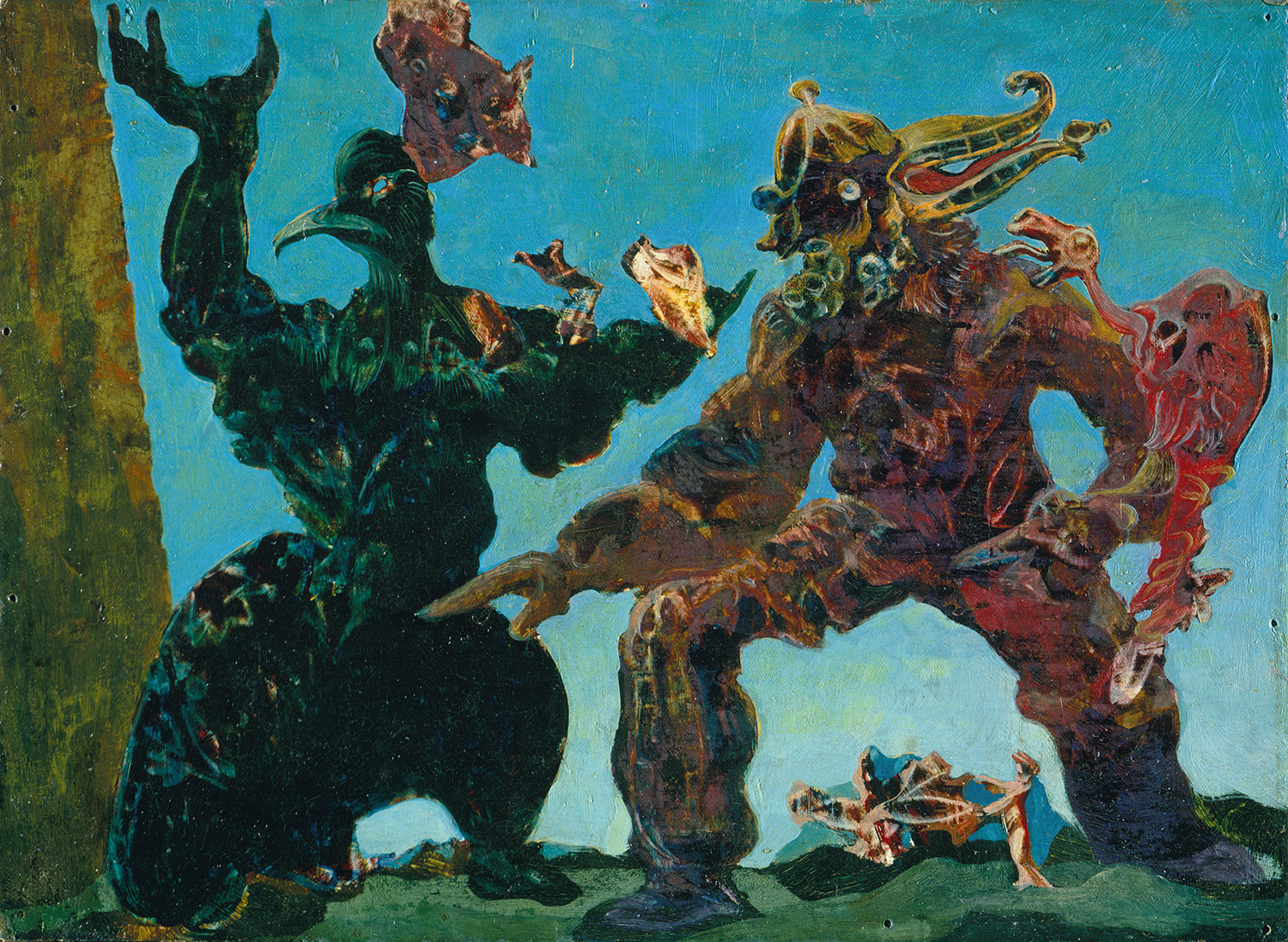
Max Ernst

This past Wednesday the Graphic Novels Book Club met to discuss Epileptic by David B., a memoir about B.’s childhood and growing up with an epileptic brother. What struck me about the book were the intricately drawn panels that depicted serpents, demons, and elaborate battle scenes. A New York Magazine review of the book stated that Epileptic does “things that only comics can do”, and I’m in complete agreement. The emotion he is able to capture just couldn’t be done using any other format.

David B. had many influences over his work, but one of the influences he mentioned in Epileptic was Max Ernst. I will admit that I know very little about art and had never heard of Ernst before, so I decided to check out a book or two at the library on him. Some of you may recognize Ernst’s name due to his influence on the members and the music of The Mars Volta. Ernst began Surrealist Automatism and was a leading member of the Dada movement. His images are bizarre, beautiful, and dreamlike, reflecting his focus on producing artwork that originated from the subconscious. While it is quite different from David B.’s work, the influence is definitely there. Of course, we have Epileptic and a number of books about Max Ernst at the library for your viewing and reading pleasure.


Epileptic by David B.

Max Ernst: A Retrospective

Max Ernst: Dada and the Dawn of Surrealism

Eight Painters: The Surrealist Context

Tuesday, July 14, 2009

Happy Vetting Day(s)!

The vetting of Sonia Sotomayor has begun and I do not envy her. Over the next several days her every public statement, every published thought, and every legal decision will be excruciatingly examined. The vetting process is typically an impressive display of cool-as-a-cucumber defense as partisan senators launch attack after attack. John Roberts came through unscathed, so too did Samuel Alito. My money says Sonia Sotomayor will as well and will be confirmed as a United States Supreme Court justice.

The vetting process is ruthless, but considering the Supreme Court is comprised of the nine elite of the elite, it is a necessary process. For discussion of the inner workings of the Court and significant moments in Court history, check out some of the following recent titles.

The Great Decision: Jefferson, Adams, Marshall, and the Battle for the Supreme Court

The Supreme Court: the Personalities and Rivalries that Defined America

Supreme Conflict: the Inside Story of the Struggle for Control of the United States Supreme Court

The Nine: Inside the Secret World of the Supreme Court

The Supreme Court: an Essential History

Sorcerers' Apprentices: 100 Years of Law Clerks at the United States Supreme Court


Sunday, July 12, 2009

Havana Deco

The moment I saw this book I had to check it out! It has given me a more complete visual understanding of a place that I continue to find fascinating. I highly recommend checking out Havana nocturne : how the mob owned Cuba-- and then lost it to the revolution in conjunction with Havana Deco. The former details a time of wild debauchery, political dealings, corruption and revolution while the latter will give you concrete examples of the breathtakingly beautiful neighborhoods and buildings that served as the backdrop to the human drama of pre-Castro Cuba.

Friday, July 10, 2009

That Snarky, Exclusive Art World

The Library has two new interesting books on the contemporary art market. In her book about the exclusive world of expensive art, Seven Days in the Art World, Sarah Thornton notes that contemporary artists have sold works for record prices in recent years, including a Jeff Koons sculpture that went for $23.6 million in 2007 and a Lucian Freud painting that sold for $33.6 million in May 2008. The book was published before the October 2008 crash, so prices have gone down since then, but money is still flowing.


For example, I recently read in the NYT that Richard Prince’s paintings have dipped in price. Much favored by hedge-fund managers, Prince’s "nurse" paintings soared from less than $100,000 to as much as $6 million in the course of five years. In June, the first nurse painting to be sold since prices crashed was closely watched. Country Nurse, which had been valued at 5 million sold for $2.9 million – down perhaps, but still a great return on the original price.

One reason for the high prices, according to Thornton, is that many people still see art as a good investment. Another reason is simply that, "it's so expensive," she writes. "High prices command media headlines, and they have in turn popularized the notion of art as a luxury good and status symbol."

The $12 million Stuffed Shark: the Curious Economics of Contemporary Art offers an entertaining Freakonomics approach to the economics and psychology of the contemporary art world. The author explains why a smart New York investment banker would pay $12 million for the decaying, two ton stuffed carcass of a shark, and attempts to determine what makes a particular work valuable while others are ignored.

For more news on the world of high art, read the NYT and Faulk Central’s art magazines.

Art in America
Artforum International
ArtNews
Flash Art

Wednesday, July 08, 2009

Miniature homes


They are minuscule, incredibly cute and irresistible: yes, we are talking about dollhouses. They are like magnets for people of all ages; when on exhibit, you will always see people standing in front of them for several minutes just marveling at the details of the furniture, and decoration.

During the seventeenth century, dollhouses were superb creations and were commissioned by wealthy collectors. Two centuries later, once they went out of fashion is when they became available for children as a toy. In the beginning of the 20th century, dollhouses started to be popular again among adults and right now, they are mainly considered an adult hobby. They can be handmade or commercially made. Furniture can be bought. Some collectors make by hand the house’s furniture and decoration themselves. Some will portray a Victorian house but others will have a more modern décor. Their furniture is usually made to a scale of 2/3 inches or one inch, depending if the dollhouse is intended for children or adult collectors.

The idea of a dollhouse is to make you feel that there is somebody actually leaving in the house. If the interior of the house is too tidy, it would look like a showroom and not like an inhabited house.

Austin Public Library has a dollhouse in permanent exhibit: Wisteria Chateau a very elaborate house made by Marie Anne Osborne, who donated this house to the library for the community to enjoy.

If you are wondering how to build a dollhouse or its furniture, the Austin Public Library has a lot of different books that can help you on your journey. Here are some examples:

The beaded dollhouse : miniature furniture and accessories made with beads

Dolls' house : inspirations

Decorate a doll's house : authentic period styles from 1630 to the present day

Antique & collectible dollhouses and their furnishings

Thirties & forties in 1/12 scale

The dolls' house wedding book

Victorian dolls' house projects: a day in the life


Dollhouse decor: creating soft furnishings in 1/12 scale


Complete Doll’s House Book

Monday, July 06, 2009

Potassium Nitrate, Sulfur and Charcoal Make What?

If you didn't see any fireworks this past weekend, you must live in a hole. Or in an entirely different country. The United States celebrated Independence Day and fireworks are one of the main ingredients to do so. Have you ever wondered about fireworks and what makes them work? I have, and I've done a little investigating.

Britannica Online defines the two types of fireworks: "force-and-spark and flame. In force-and-spark compositions, potassium nitrate, sulfur, and finely ground charcoal are used, with additional ingredients that produce various types of sparks. In flame compositions, such as the stars that are shot out of rockets, potassium nitrate, salts of antimony, and sulfur may be used. For coloured fire, potassium chlorate or potassium perchlorate is combined with a metal salt that determines the colour."

AccessScience has a nice entry on pyrotechnics and fireworks, citing that "[a] pyrotechnic mixture contains a fuel and an oxidizer, usually another ingredient to give a special effect, and often a binder."

We've got a few books on the topic, check them out for further information:

Gunpowder: Alchemy, Bombards, and Pyrotechnics: the History of the Explosive that Changed the World by Jack Kelly

Pyrotechnics by Alexander Hardt

Fourth of July Fireworks by Patrick Merrick

Fireworks: Principles and Practice by Ronald Lancaster

Fireworks: the Science, the Art, and the Magic by Susan Kuklin

We've even got a DVD on fireworks and the science behind them:

Fireworks


Search for an article about fireworks in any one of our newspaper, magazine or journal databases. Try PressDisplay if you haven't already, it's one of my favorites right now!

And for those who are really in to fireworks, check out the biggest fireworks festival in the world, going on right now in Montreal, the Montreal Fireworks Festival. The United States competes on Saturday, August 1st. They're celebrating the 25th anniversary, so I'm sure this year's fireworks will be extra special.

(image from everystockphoto.com)

Saturday, July 04, 2009

Happy Birthday, Barcode

The library may be closed today, but while you’re out shopping for your big Independence Day celebration, think of what life would be like without those handy barcodes that can be found on every item you purchase. It just so happens the barcode turned 35 years old on June 26 this year. While this may seem relatively insignificant, it was reported in a New York Times article that barcodes are scanned over 10 billion times a day throughout the world. The barcode has certainly changed the ease with which we shop, but the future of the barcode may prove to be even more effectual with the further development and increased use of the RFID. Just as the barcode was controversial when it initially came out, so too is the use of RFID technology. In the 1970s some people were against the barcode believing they would be overcharged at the register without a price tag. Today RFID brings up a whole set of new issues, in particular, the tracking of individuals through RFID chips.

Nonetheless, the barcode has not only improved shopping experiences, but also customer experiences here at the library. With our new self-check out machines at the Central library, people are using barcodes to check out their own books, DVDs, and CDs. In fact, this month we set a new record: over 40,000 items were checked out from the Central library using our self-check machines! That’s right, of the 80,000 books, DVDs, CDs, etc. that checked out, more than 40,000 were checked out using the new machines. We think this might reflect how much all of you like the new machines, but, at the very least, it is real example of how barcodes can change the way things are done.

I hope everyone has a safe, happy holiday.

New York Times article:
Game Changer in Retailing, Bar Code Is 35

More info about RFID:
How RFID Works

Thursday, July 02, 2009

Iran and nuclear-non proliferation


It has been over two weeks since the Iranian presidential election. Protests continue, and so do assertions from Iranian authorities that the election was legitimate. Initially, the Obama administration responded tepidly. On one hand, they needed to condemn the travesty of a tainted election and subsequent crackdowns. On the other hand, they sought to respect a nation’s sovereignty and Iran’s ambiguous nuclear program requires that the USA work towards improved relations. Another nuclear state is not good for anyone. An angry nuclear state is infinitely worse. Reflecting on the past couple of weeks, the USA and the rest of the west seem to have done a nice job straddling the issue: condemning the Iranian authorities’ actions without condemning the country.


July 1, 1968 saw the signing of The Treaty on the Non-Proliferation of Nuclear Weapons. Sixty-two nations concurrently signed the treaty in Washington, London, and Moscow. The treaty stemmed from a collective fear of the massive piles of nuclear weapons being amassed and the collective understanding that an increase in nuclear weapons made nuclear war more likely.


While considering the mindboggling concept of nuclear war, I recently stumbled upon a gem of a book by Bertrand Russell. Common Sense and Nuclear Warfare is the prolific philosopher’s recommendation on improving international relations, nonproliferation, and nuclear war avoidance. Weighing in at less than one hundred pages, the slim volume packs a punch.


Another wonderful resource available through the Austin Public Library is CQ Researcher. This database provides detailed analysis of myriad national and global topics. The entry for nuclear proliferation details nuclear development and debates issues involved. Iran is also covered equitably within numerous contexts.


PressDisplay is another incredible database available through the Austin Public Library. It contains over 800 newspapers from around the world, available the same morning they are printed. Press Display is a wonderful way to read variations in coverage and international opinion.


Wednesday, July 01, 2009

Tumblebooks for Hot, Summer Days


Tumblebooks is an extensive online library available from your computer. You'll find online read-alongs and animated versions of picture books.

Tumblebooks is great used at home for preschoolers who would like more "lap time," beginning readers and ESL students who need some extra help and high school students who need to listen to that last minute classic. Kids can independently follow along to listen to stories with the words highlighted as they read.

Some exciting features:
  • Story Books. Favorite picture books are animated. Most titles are paired with quizzes and games.
  • Tumble Readables. Beginning readers are presented read-along style. An audio of the book being read aloud is paired with highlighted text so that kids can follow along.
  • Language Learning. Tumblebooks includes a growing number of Spanish-language titles.
  • An Index. Click on 'Index' for a quick way to jump to the titles you would like to find.
  • Audio Books. Tumblebooks provides a selection of classics like The Adventures of Huckleberry Finn in audio-only format.